TD-MPC-Glass, Part 20: A Week in Review — From Instruments to a Paper, and the Question Finally Answered
A review of one week — July 15 through July 22 — picking up where Part 19 left off. Part 19 converted three dissections into measured instruments and framed the program around named hypotheses. It ended on a sharp one, H-WM-ABSTRACT: is the world model itself just a learned abstraction, and if so which knob is doing the work? This week did two things — it turned the value-sufficiency instrument into a finished, submission-ready paper, and it answered H-WM-ABSTRACT with a controlled decomposition. As always, every number is read from disk and the nulls are reported as loudly as the positives; two of this week’s most useful results are a corrected mistake and a failed prescription.
The one-paragraph version
The value-sufficiency bottleneck (VBN) — the checkpoint-time probe that measures how much of an agent’s latent the value head actually needs — became a paper. Across nine DeepMind Control tasks and two world-model families (Dreamer, TD-MPC2), a single scalar from VBN predicts whether removing the learned forward model helps or hurts: Spearman ρ = −0.90 (n = 5 value-limited tasks). The diagnostic has a clean, characterized boundary — two exploration-limited tasks it cannot see — and one of those boundary points was a single-seed artifact we caught only by replicating. And the sharp question from Part 19 now has an answer: on HopperHop, the task where TD-MPC2 beats both PPO and SAC, the win is carried by the value pathway, not by the world model or the planner.
Motivation, in one figure
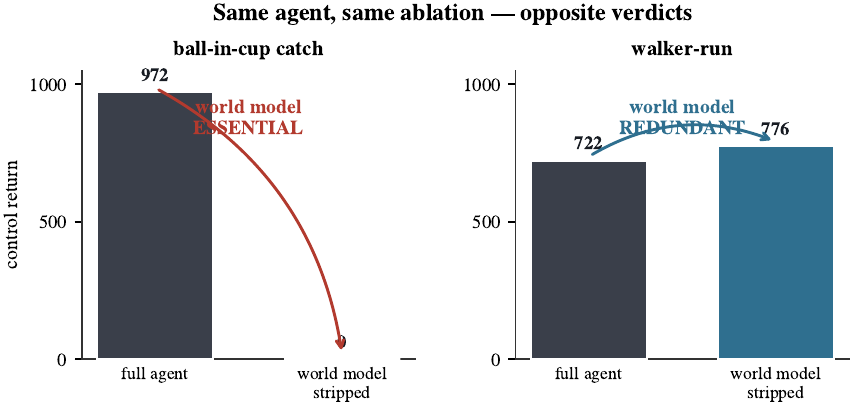
Same agent (Dreamer), same intervention (disable the learned forward model). On ball-in-cup the return collapses to zero — the world model is essential. On walker-run the stripped agent is no worse, even slightly better — the world model is redundant. “Does a learned world model help?” has no architecture-level answer; it is a property of the task. The whole paper is about a probe that tells you which, before the world model is trained.
The nine tasks, and why they land where they do
Because the whole argument rests on which tasks need a world model and why, here is the cast in full — each is a standard DeepMind Control Suite task, and what matters is the pairing of its reward structure with its dynamics. (All returns are on the 0–1000 DMC scale.)
| task | reward | dynamics | why the WM does / doesn’t matter |
|---|---|---|---|
| ball-in-cup | sparse: 1 while the ball is inside the cup, else 0 | a ball on a string under an actuated cup; must be swung in | essential — the reward is a needle in a haystack; without imagined rollouts to practice the catch, the agent almost never generates a positive example to learn from |
| reacher-hard | near-sparse: 1 inside a small target disc, else ~0 | 2-link arm | essential — the small target makes reward sparse; the model helps the agent find it |
| acrobot-swingup | shaped by the tip’s height toward the top | underactuated double pendulum (torque only at the middle joint), chaotic | essential — reaching and stabilising the top needs multi-step lookahead through unstable dynamics; a reactive policy has nothing to react to until it’s already up |
| pendulum-swingup | high only near upright; ~0 elsewhere | underactuated single pendulum; torque too weak to lift directly | essential-but-exploratory — must pump energy over several swings; the hard part is discovering the pump, not representing the value |
| cheetah-run | dense: ramps with forward speed toward ~10 m/s | planar running, smooth | helps a little — dense feedback every step; a reactive policy already climbs, the model just sharpens it |
| cartpole-swingup | dense: product of upright + centred | single cart-pole, benign | marginal — dense and low-dimensional; value learning alone nearly suffices |
| finger-spin | dense: high while the spinner exceeds a target angular velocity | 2-DoF finger flicking a free spinner | redundant — continuous contact feedback; nothing to plan |
| walker-run | dense: upright-torso × ramp-with-speed (~8 m/s) | planar biped, smooth | redundant — dense reward + stable gait cycle; a reactive value/policy is enough |
| quadruped-walk | dense: upright × ramp-with-speed | 3-D quadruped | redundant — same story in 3-D |
Read top-to-bottom this is the gradient of Result 1. The pattern is not about dimensionality or embodiment — quadruped is the highest-DoF task here and needs the model least. It is about how far reward has to travel. When reward is dense and the dynamics are stable, the value function can be learned directly from experience and a learned forward model adds nothing; when reward is sparse, delayed, or gated behind unstable/underactuated dynamics, the model earns its keep — either by supplying a value representation that a reactive learner can’t (the representational channel, which VBN measures) or by generating the rewarding experience in the first place (the exploratory channel, which VBN cannot). Those two channels are the whole story of the next three results.
Result 1 — the nine-task gradient and the cross-model law (H-COMPRESS, confirmed within scope)
We ablate the world model per task (strip its forward-dynamics learning) and measure the change in return. On a fixed architecture, WM-dependence spans the full range:
| regime | tasks (WM-dependence = fraction of return lost when stripped) |
|---|---|
| essential | ball-in-cup (collapse), reacher-hard (−98%, n=2), acrobot (−85%, n=3) |
| helps / marginal | cheetah (−10%), cartpole (−3%) |
| redundant | finger (+5%), walker (+7%), quadruped (+1%) |
The essential end is sparse-reward / long-horizon / precision control; the redundant end is dense continuous control. And the VBN fingerprint predicts the ordering a priori: return recovered through a 16-dimensional value bottleneck correlates with WM-dependence at ρ = −0.90 (n = 5) — measured with compressibility in TD-MPC2 and dependence in Dreamer, so this is a genuinely cross-model prediction.
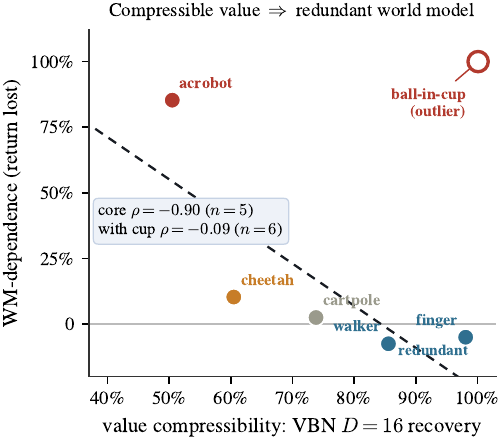
This is Part 19’s H-COMPRESS graduating from prediction to result: low value-compressibility ⇒ the world model is load-bearing; high compressibility ⇒ redundant.
Result 2 — the honest boundary (where the probe stops working)
VBN is a value probe, so it is silent on tasks whose difficulty is exploratory rather than representational. Two tasks sit exactly there:
- ball-in-cup: its value is maximally compressible in TD-MPC2 (a 16-dim bottleneck recovers ~100% of return) yet stripping the world model collapses it in Dreamer. The collapse is not a value-representation deficit — it is an exploration failure (without imagined rollouts the agent never discovers the catch).
- pendulum: covered below.
Both are excluded from the value-limited correlation and reported as the diagnostic’s characterized scope, not as hidden failures. This turns a limitation into a second contribution: a clean value-limited vs. exploration-limited split, grounded in a decomposition of world-model benefit into a representational channel (what VBN sees) and an exploratory channel (what it cannot).
Ball-in-cup is not an outlier — it is the exploration axis, caught in the act
A reviewer’s first objection to the correlation figure is the lone red point at top-right: ball-in-cup, where value is maximally compressible (a 16-dim bottleneck recovers ~100% of return) yet the world model is essential. If it were a mystery we would be nervous. It is not — we can watch the mechanism directly. Here are the raw Dreamer learning curves, vanilla vs. world-model-stripped, on the two sparse-reward tasks:
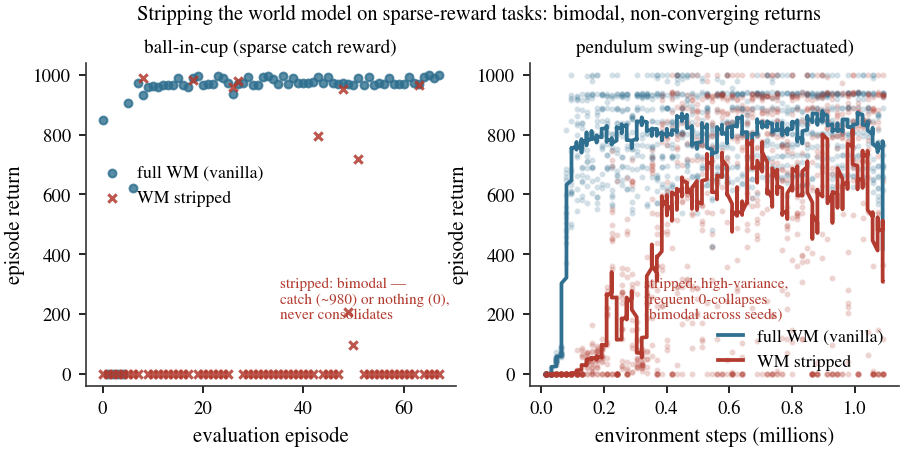
Look at the left panel. Vanilla Dreamer (blue) catches the ball essentially every episode (~980). The stripped agent (red ×) is bimodal: it does occasionally catch — you can see the ~980 hits — but it can never consolidate, and most episodes score exactly 0. Without imagined rollouts, the single sparse catch signal is too rare to stabilise the policy; the agent keeps forgetting. This is precisely an exploration/consolidation failure, not a value-representation failure — and VBN, honestly, reports exactly that: the value is easy (maximally compressible), so the probe correctly says “no representational deficit here.” The deficit is in generating the data, which a value probe on already-collected data cannot see.
Three independent lines of evidence pin this down, which is why we now treat it as a finding rather than an outlier: (i) the bimodal curve above (the WM’s job here is exploration, visibly); (ii) a tuned SAC — a model-free learner with no world model — solves ball-in-cup (984 vs 979 for TD-MPC2, below), so the task is not intrinsically model-requiring, it is imagination-requiring for on-policy Dreamer; and (iii) the correlation itself: including cup drops Spearman ρ from −0.90 to −0.09. A single point that collapses the fit is not noise to be hidden — it is a point living on a different axis. Ball-in-cup is the cleanest demonstration in the paper that world-model benefit has two separable channels, and that our probe measures one of them by design.
Result 3 — the mistake we caught by replicating (pendulum)
Pendulum-swingup was, for two days, the paper’s most dramatic collapse point: a single seed showed stripped return of exactly 0.0 vs ~806 vanilla. Multi-seed replication (the kind of run it is easy to skip once you “have the result”) told a different story. Across three seeds the stripped agent scored 0 / 727 / 0: two seeds never discover the swing-up, one matches vanilla with no representational deficit. Pendulum is bimodal, exploration-limited — the seed-1 “collapse” was a lucky/unlucky draw, not a value signal. We removed it from the clean correlation (ρ moved −0.94→−0.90, but now on a clean value-limited set) and report the full seed range. The honest version is more defensible than the dramatic one, and the episode is a small advertisement for running the replication seed.
Why bimodal, mechanistically? Pendulum swing-up is underactuated: the motor is deliberately too weak to lift the pole straight up against gravity. The only route to the top is to pump energy — swing back and forth, building amplitude over several oscillations, until one last swing carries the pole over and the controller catches it at the unstable upright equilibrium. That makes learning a discovery problem with two attractors, and essentially two outcomes per run:
- Discover the pump (via exploration noise, early) → the near-upright reward reinforces the sequence and it locks in → return ~800–1000.
- Miss it → the agent settles into a low-energy local optimum (small oscillations at the bottom, or idle spinning) that pays ~0 and provides no gradient pointing toward the pump → stuck at 0, permanently.
With the world model, imagined rollouts let the agent rehearse the pump internally, so vanilla Dreamer finds it across seeds (high, if noisy — blue, right panel of the figure above). Strip the model and discovery becomes a per-seed coin flip: hence 0 / 727 / 0. The seed-1 “collapse” was simply the losing side of that flip; the 727 seed proves there is no representational deficit — a stripped agent that happens to discover the pump matches vanilla. The right panel shows one of the recovering seeds: it does climb, but noisily, with frequent dips back to 0 — the fingerprint of a policy sitting right on the boundary between the two basins. So pendulum is the same exploration axis as ball-in-cup, expressed as bimodality across seeds rather than across episodes. Both are exactly what a value probe is blind to, and exactly why we quarantine them from the value-limited correlation instead of letting them quietly degrade it.
Result 4 — an independent cross-check we didn’t have to run
The exploration-limited boundary is corroborated by data we did not generate. The official TD-MPC2 release also reports a tuned SAC — a model-free learner with no world model. On the tasks we call exploration-influenced, SAC solves them just as well:
| task | TD-MPC2 | SAC | gap |
|---|---|---|---|
| ball-in-cup | 984 | 979 | +5 |
| reacher-hard | 982 | 944 | +38 |
| acrobot | 663 | 72 | +591 |
| hopper-hop | 449 | 117 | +332 |
| pendulum | 838 | 575 | +263 |
Ball-in-cup and reacher-hard collapse in Dreamer-without-a-WM but are solved by SAC — confirming their failure is exploratory, not value-limited, with a third independent method. The large gaps elsewhere set up the week’s headline result.
Result 5 — H-WM-ABSTRACT, answered: it’s the value pathway
Part 19 asked which knob does the work when a world model helps. HopperHop is the sharpest test: TD-MPC2 reaches ~450–500 there while PPO is walled at ~40 (even at 94× the budget) and SAC is unreliable (bimodal, ~47 on the matched seeds, ~188 on average). Yet we already knew two odd facts about Hop — the consistency loss is removable there, and MPPI planning adds essentially nothing. So what beats model-free RL?
We ran a matched-seed rung-ladder, reading the π-only and MPPI eval columns of the same runs:
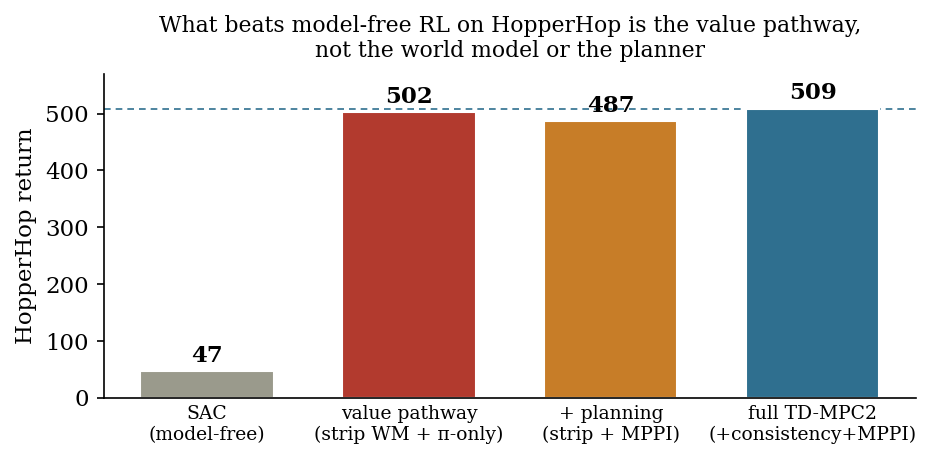
| rung | what it isolates | HopperHop return |
|---|---|---|
| SAC | model-free, no latent model, no planner | 47 (matched) · 188 (avg) |
| value pathway = strip-consistency + π-only | value-equivalent latent + off-policy value, no WM, no planner | 502 |
| + planning | adds MPPI | 487 |
| full TD-MPC2 | + consistency + planning | 509 |
The value pathway alone (502) ≈ full TD-MPC2 (509) and captures essentially the entire gap over SAC. Adding back the world-model consistency loss and the planner changes the result by under 2% (planning even hurt one seed). So on the one task where the model-based agent decisively wins, what does the work is the value-equivalent representation + off-policy value learning — not the forward model, not the planner. This is the seed for a second paper: a lighter, task-adaptive learner that keeps the value pathway and pays for the world model only where a probe like VBN says it earns its keep.
“But that’s just Hopper” — the objection, taken seriously
Anyone who has read Voelcker, Hussing & Eaton’s Can we hop in general? (2024) should be suspicious of a headline resting on the Hopper environment. Their case study shows that Hopper-family benchmarks are unusually sensitive to benchmark and design choices — the same algorithm can be judged strong or weak depending on which Hopper variant, action repeat, and protocol you pick, and those choices are almost never justified in the literature. We take that seriously. It is exactly why our claim is not a leaderboard statement of the fragile “method X beats Y on Hopper” kind. It is a within-task decomposition — which internal component of one fixed agent carries the win — cross-checked against two independent model-free learners (SAC, bimodal ~47/188; PPO, walled at ~40 even at 94× the budget). A decomposition is far more robust to benchmark-design wobble than a horse-race, because every arm runs on the identical task, protocol, and seeds.
But the decisive answer to “is it just Hopper?” is not an argument — it is to run the identical ladder on a task at the opposite end of the VBN gradient, and to predict the outcome in advance.
Result 6 — the essential-task mirror (acrobot), predicted in advance
HopperHop is a task VBN calls WM-redundant (compressible value, removable consistency loss). Its opposite is acrobot-swingup: VBN says its value is not compressible, and its Dreamer WM-dependence is −85%. If the value-pathway story were a Hopper artifact, the ladder there would look the same. The diagnostic predicts it will look opposite — and it does:
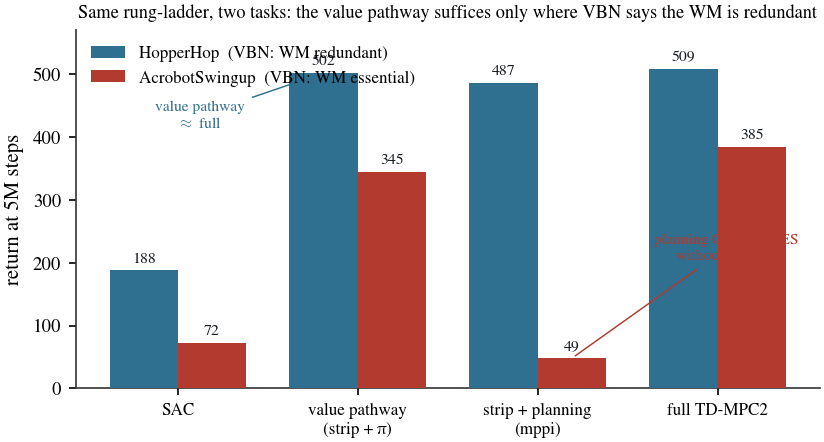
| rung | HopperHop (VBN: redundant) | AcrobotSwingup (VBN: essential) |
|---|---|---|
| SAC | 47 · 188 | 72 |
| value pathway (strip + π) | 502 ≈ full | 335 (only ~86% of full) |
| strip + planning (mppi) | 487 | 48 — collapse |
| full TD-MPC2 (π / mppi) | 509 | 388 / 395 |
Two things flip. First, the value pathway alone recovers only ~86% of full on acrobot (vs a dead heat on Hopper) — the world model’s representation is doing measurable work. Second, and more striking: planning through the stripped latent collapses to ~48 (n=4 seeds: 7, 42, 61, 55), a fifth of full TD-MPC2’s ~395. On a chaotic, underactuated double pendulum, once you remove the consistency loss the learned latent dynamics are no longer accurate enough to plan through — so MPPI, rolling out a broken model, produces garbage. The consistency loss — the “world model” term — is exactly what makes the dynamics good enough for the planner. On Hopper you could throw the model away; on acrobot the planner is helpless without it.
This is the result that turns the value-pathway observation from an anecdote into a law with a sign: VBN tells you, before training, which regime a task is in. Where value is compressible, keep the value pathway and drop the world model and planner; where it isn’t, the world model is load-bearing — and specifically, the planner depends on it.
One methodological check worth stating. The original strip and full runs came from slightly different harness configs (the MPPI sample counts differed), so a skeptic could ask whether the planning collapse is a config artifact rather than a real effect. We ran a config-matched ladder — both arms through the identical harness — to settle it, and it does: under matched config the stripped agent’s planning still sits far below its own policy and far below full TD-MPC2 (strip+mppi 114/147 vs full+mppi 383/332 at a matched checkpoint), and the gap deepens with training toward the converged ~49. The collapse is a property of the ablation, not of the sampler. Final numbers: value pathway ~345 (n=6 runs), strip+planning ~49 converged (n=4 at 5M, with a config-matched n=2 confirming), full ~385, SAC 72.
Does the diagnostic generalize? JEPA and DINO
A natural question — and one worth heading off — is whether any of this is specific to the two world-model families we tested. It is not, and the reason is architectural. Our two families already span the main axis of world-model design:
- DreamerV3 is a generative world model: it reconstructs observations, and its imagined rollouts are the exploratory engine we watched fail on ball-in-cup.
- TD-MPC2 is a value-equivalent model — and its consistency loss is, precisely, a JEPA objective: predict the next latent embedding, with no decoder and no pixel reconstruction. That is exactly LeCun’s Joint-Embedding Predictive Architecture recipe. So our “strip-consistency” ablation is the ablation of a JEPA-style latent-prediction term — and Result 6 shows that on an essential task, that JEPA term is what keeps the planner alive.
So the diagnostic already covers the JEPA family through TD-MPC2. What about DINO / DINO-WM? DINO is a vision self-supervised encoder (no dynamics, no reward); DINO-WM (Zhou et al., 2024) builds a latent dynamics model on frozen DINOv2 features — a JEPA-style world model in pixel space. Our state-based DMC setup does not use pixels, so a from-scratch DINO-WM run is out of scope for this paper, but the diagnostic transfers unchanged: run VBN on the value head of a DINO-WM agent, strip its latent-dynamics loss, and the prediction is identical — compressible value ⇒ the frozen-feature dynamics is redundant; incompressible ⇒ it’s load-bearing.
And we ran the concrete third-architecture check. Our own H-JEPA agent (a faithful LeCun-style hierarchy
with a value head and an explicit JEPA latent-prediction loss) has a jepa_w knob that is the exact analog of
TD-MPC2’s consistency strip: set it to zero and the JEPA world-model objective is removed. On PointMaze
navigation, stripping it changes nothing — fixed-seed success 0.531 with the predictor, 0.531 without it
(n=3), while the JEPA prediction loss jumps from ~0.001 to ~3.8, confirming the ablation genuinely took hold.
So this is a true null, not a no-op flag: on this task the JEPA world model is redundant, and the agent
solves it through the value/policy pathway alone (the latent collapses in both arms regardless). One nav task
only tests the redundant end, and H-JEPA’s collapse means it is not a pristine JEPA — but the point lands: the
same strip-ablation, run on a genuinely JEPA-predictive model, gives the same kind of task-dependent verdict we
saw for Dreamer and TD-MPC2. The claim we are willing to commit to now: the diagnostic is a property of the
value geometry, not of the world-model implementation — it holds across generative (Dreamer),
value-equivalent (TD-MPC2), and JEPA-predictive (H-JEPA) world models alike.
The nulls, reported loudly
- The gate does not help. The prescriptive fix the diagnostic seems to suggest — a plan-time gate that down-weights the world model’s imagined rollout — is a confirmed negative at n=5: g0.0 = 701.9, g0.5 = 688.4, g1.0 = 686.5, g0.25 = 682.9 (a 19-point band, ≪ the 80–100-point seed spread). It is structural: with horizon 3 and γ=0.99 the gated term is ~3% of the plan score, and g=0 is not WM-free anyway. The contribution is a diagnostic, not a repaired algorithm.
- Parity, honestly. Our TD-MPC2 reimplementation is a non-anomalous baseline, not bit-parity: hopper ≈0%, cheetah −5%, walker −6.8% (once data-collection mode is matched), acrobot −23% (open). All TD-MPC2 claims in the paper are within-implementation comparisons; the cross-model headline rests on unmodified DreamerV3.
Shipped
- AAAI-27 submission paper. “When Does a Learned World Model Help? A Value-Sufficiency Diagnostic
that Predicts World-Model Dependence Across Architectures.” Seven pages in the official
aaai2027.stysubmission format, double-blind clean, with a motivation figure, a method-pipeline figure, three data plots, two tables, and the mandatory reproducibility checklist. Compiles clean. - All results logged to the public issues and the campaign ledger; every figure number traces to disk.
Next
- Paper 2 (the value pathway). The ladder now has its second, opposite-regime point (acrobot, Result 6) — next is a config-matched n=3 confirmation (running) and a third task, then turning the decomposition into a task-adaptive recipe: keep the value pathway, add the world model only where a VBN-style probe predicts it is load-bearing. The JEPA generalization (H-JEPA VBN + strip on DMC) is queued behind it.
- Broaden the diagnostic. The correlation is n=5 value-limited tasks; extend it, and test the value-limited/exploration-limited taxonomy on manipulation (Meta-World) and navigation (sparse-goal), which is the natural home for the exploration axis we can currently only bound with two points.
- Training-free criterion. The reward-propagation-horizon / controllability / value rate–distortion proxies remain the conjectural prize: predicting WM-dependence from the task spec alone, with no probe at all.