TD-MPC-Glass, Part 19: A Week in Review — Turning Three Dissections Into Instruments
A review of one week — July 8 through July 15 — picking up where Part 10 left off. Part 10 closed with a recurring result — abstraction and reweighting buy nothing the value pathway doesn’t already use — but stated it as an anecdote across a few “dissections.” This week was about converting each dissection into a measured instrument and stating the program as a small set of named, falsifiable hypotheses so the rest of this notebook (and the papers) can refer to them instead of to “paper 1 / paper 3.” Every figure is read from disk; nulls are reported as loudly as positives.
The four hypotheses this program is testing
First, two terms the whole program turns on:
- The base objective is what TD-MPC2 already optimizes without any of our additions: a value/TD loss (predict discounted return) plus a latent-dynamics (“consistency”) loss (predict the next latent), with the MPPI planner choosing actions by rolling that latent model forward. The representation — the latent — is simply whatever vector the network learns in order to satisfy those losses.
- Explicit structure = any hand-designed representational objective we bolt on top of the base objective. Concretely, the menu is: the consistency loss (treated as an ablatable knob), an anti-collapse penalty (uniformity, VICReg), SimNorm, a structural-entropy / “glass” latent, clustering / discretization, or a behavioral prior (TAMP, skill-options). The single question behind this program is: when does adding explicit structure beat just letting the base objective shape the latent on its own?
With those fixed, the four hypotheses:
-
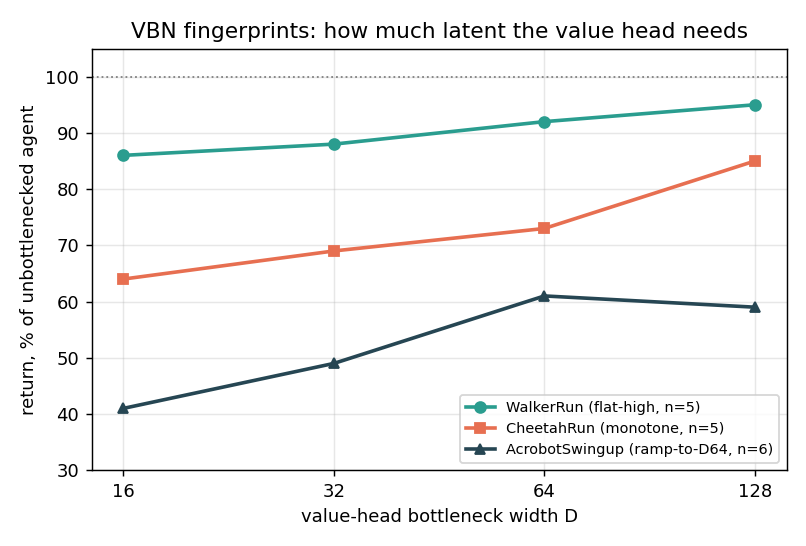
H-COMPRESS (value-information compressibility) — a PREDICTION still under test, not a result. Claim: adding imposed structure (anti-collapse / SE / SimNorm) helps only on tasks where the value head needs just a small slice of the latent (the flat-high regime). Intuition: if the value/TD objective already spends the entire latent computing value, the representation is “full” — no spare capacity for an added objective to reorganize. If the value head needs only a little, the rest is effectively free, and an added objective might have room to shape it usefully. Status (be honest): the leap from “there is free capacity” to “filling it with structure helps” is not yet demonstrated. Our one completed add-structure test is #59 on Cheetah (least-compressible) — null, as expected there. The decisive positive test is on WalkerRun (most-compressible), running now; its interim read shows no separation between arms. If Walker finishes null, H-COMPRESS’s positive half is falsified and the cleaner statement is “imposed structure is redundant everywhere.” How we measure “how much of the latent the value head needs”: the value-sufficiency bottleneck (VBN) — force the value head’s input through a width-(D) bottleneck and sweep (D\in{16,32,64,128}). If return barely drops at small (D), the value-relevant information is highly compressible (the head needs little → room to help). If return falls off smoothly as (D) shrinks, the head needs the whole latent (no room). The punchline: the thing that predicts “is there room to help” is this compressibility, not the two quantities you’d naively guess — the task’s planning horizon length, or its family (locomotion vs manipulation). Two locomotion tasks (Walker, Cheetah) land at opposite ends of the compressibility axis; that is why family and horizon fail as predictors and compressibility succeeds.
-
H-WM-ABSTRACT (the world model is a learned abstraction). Claim: the latent-dynamics model the consistency loss trains is itself an abstraction — a learned, task-relevant compression of the observation. So “world model” and “abstraction” are not two different things to compare; the world model is one kind of abstraction (learned), on the same axis as the imposed ones (SE / SimNorm / glass). Consequence: “stripped vs full” (deleting the consistency loss) is already an abstraction ablation — of the learned abstraction — and the clean experiment is to ablate a learned and an imposed abstraction together, per task, to see which piece is the working part.
-
H-COLLECT (collection mode gates the world model’s value). Claim: how much the world model matters depends on who collects the data — the reactive policy (our default) or the planner (canonical TD-MPC2: MPPI rolls the model forward to act). Why it could matter: under planner-collection the model doesn’t merely score candidate actions, it generates the behaviour that becomes the next batch of training data — so an inaccurate model can steer its own data collection, feeding its errors back in.
-
H-VARIANCE (one mechanism, two regimes). Claim: under planner-collection, the net effect of the world model is to inflate the variance of the returns the planner chases (~3× in our runs). Whether that extra variance is good or bad is set by the ratio of the mean return to that variance: a high mean keeps the swings net-positive (Walker); a low mean lets the swings drag returns below a stable no-model baseline, so the model turns net-harmful (Cheetah — the inversion). One mechanism, opposite signs.
Are these hypotheses actually useful, or just relabeling? Fair question — they are not equally load-bearing:
- H-VARIANCE is the most useful: it made a concrete, measured prediction (the world model inflates planner-target variance ~3×, sign set by mean/variance ratio) that you can compute per task from eval traces to forecast whether planner-collection will help or hurt — a decision procedure, not a label.
- H-COMPRESS is useful as a cheap screen: run the VBN before spending compute on structure, and skip tasks where the value head needs the whole latent. Its negative (redundancy) side is well supported; its positive side (“structure helps in flat-high”) is unproven and under test.
- H-COLLECT is a real, testable factor (collection mode), but see the confound caveat in Instrument 2 — we have not yet run the clean factorial that would let us attribute an effect to it.
- H-WM-ABSTRACT is, honestly, mostly a reframing right now. Its only cash value is that it makes one experiment well-posed — the cross-ablation (ablate learned and imposed abstraction together). If that experiment’s outcomes don’t come apart, the hypothesis is just a relabeling and should be dropped.
That triage is itself the point of naming them: a hypothesis earns its keep only when it changes what we do next.
Instrument 1 — the value-sufficiency bottleneck (evidence for H-COMPRESS)
Part 10’s probe was decode-(R^2) — how well the latent reconstructs the observation. It saturates for both a strong policy and a collapsed one, so it can’t tell you whether structure has room to help. The replacement is a value-sufficiency bottleneck (VBN): insert a width-(D) bottleneck on the value head’s input, sweep (D\in{16,32,64,128}) against the unmodified agent, and read the shape of the curve. That shape is a per-task fingerprint of how much of the latent the value function needs.
| Task | D=16 | D=32 | D=64 | D=128 | vanilla | fingerprint |
|---|---|---|---|---|---|---|
| WalkerRun (n=5) | 625 (86%) | 643 (88%) | 666 (92%) | 694 (95%) | 727 | flat-high — most compressible; D=16 already 86% |
| CheetahRun (n=5) | 548 (64%) | 589 (69%) | 627 (73%) | 726 (85%) | 855 | strictly monotone — no width suffices |
| AcrobotSwingup (n=6, med) | 211 (41%) | 251 (49%) | 311 (61%) | 304 (59%) | 511 | ramp-to-D64 — least compressible; saturates at D=64 |
| HopperHop | — | — | — | — | — | not yet swept (queued) — the removable cell; H-COMPRESS predicts flat-high |
The instrument agrees with the intervention. The stripped-vs-full ablation (delete the consistency loss) ranks the tasks the same way the fingerprint does:
\[\text{HopperHop } 0\% \;<\; \text{WalkerRun } {-}7.5\% \;<\; \text{CheetahRun } {-}23.8\% \;<\; \text{AcrobotSwingup } {-}44\%.\]Read carefully, this co-ranking is evidence for H-WM-ABSTRACT, not H-COMPRESS — and the direction matters. The strip cost measures how much the learned world model carries; it is largest where compressibility is LOWEST (Cheetah −24%, Acrobot −44%) and zero where the task is most compressible (Hopper). So the learned abstraction is load-bearing exactly where the value head needs a lot of the latent — the opposite end of the axis from where imposed structure is supposed to help. Two distinct statements, easy to conflate:
- Learned abstraction (world model) is load-bearing in low-compressibility tasks — proven here.
- Imposed structure helps in high-compressibility (flat-high) tasks — H-COMPRESS’s prediction, still under test (Walker), interim null.
This sharpens Part 10’s Q6 (“why did abstraction ever help on HopperHop/nav?”) rather than closing it. Q6 was about imposed abstraction on high-compressibility tasks — precisely the claim that is still open (instrument 3, Walker running). What the co-ranking settles is the other half: the learned world model is load-bearing on the low-compressibility tasks, and removable where compressibility is high (Hopper 0%). So Hopper is the clean case where neither abstraction is needed — the value pathway plus a rough planner already suffice.
Two honest limits of the instrument (both now queued as experiments, not swept under the rug):
- It probes the value head only. That is deliberate — the planner selects actions by rolling the model and scoring with the value/reward heads, so value-sufficiency is the pathway that gates planning. But it means the fingerprint does not yet speak to the reward or dynamics heads; a head-by-head bottleneck sweep is queued.
- HopperHop has no row. We only swept the three DMControl tasks above; the Hopper VBN sweep is queued (H-COMPRESS predicts flat-high, matching its removable status).
A rigor note: the Acrobot fingerprint was called “step-at-128” mid-week. On re-harvest, two seeds had only reached ~2.7M steps and were dragging the means; on the six complete-at-5M seeds it is a smooth ramp saturating at D=64. Same story, corrected location. Report medians (two collapse cells).
Instrument 2 — collection mode and the world model (evidence for H-COLLECT + H-VARIANCE)
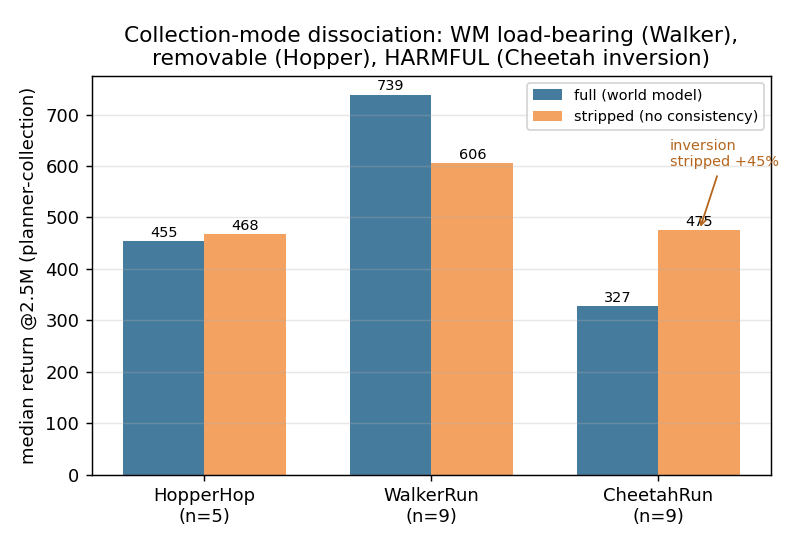
Our JAX variant collects with the policy; canonical TD-MPC2 collects with the planner. Under planner-collection, re-running stripped-vs-full on three tasks gives a double dissociation with a genuine inversion (finals @2.5M, now n=9):
| Task | full (median) | stripped (median) | Δ | reading |
|---|---|---|---|---|
| HopperHop (n=5) | ~455 | ~468 | ≈0 | removable — both arms stable |
| WalkerRun (n=9) | 739 | 606 | −18.0% | load-bearing — higher but volatile |
| CheetahRun (n=9) | 327 | 475 | +45% (stripped > full) | inversion — the model is actively harmful |
On Cheetah, removing the model’s accuracy helps by 45% — we had pre-registered the opposite (≥15% degrade). That falsification is the spine of the section, and it is evidence for H-COLLECT: the world model’s value is not a constant, it is gated by collection mode and task.
The why is H-VARIANCE, and it is readable straight off the eval traces. The full model inflates eval-return variance ~3× on both tasks. The tasks differ only in scale relative to the mean: on Walker the model lifts the mean to ~740 so the swings stay net-positive; on Cheetah the swings drag finals to ~117, below the stable stripped model (~475), so variance tips into net harm. One mechanism, two regimes, set by the mean/variance ratio.
This also dissolves Part 10’s Q8 (Hopper is both the sharpest PPO wall and the only removable cell): stripping consistency removes the model’s accuracy but not the planner. TD-MPC2 clears Hopper via planning + off-policy data (Q5: deterministic actor, no entropy — SAC fails Hopper 0/9 while the planner-free TD core is 8/8), and the model is removable because the planner carries it.
So the two headline conclusions — (a) the world model’s value is task-dependent, (b) planning-in- collection is (mostly) a sample-efficiency operator — now have a shared mechanism underneath (a), not just an observation: it is the variance-inflation of H-VARIANCE, with the sign flip explained.
Confound caveat — this is not yet a clean factorial (a reader raised this, correctly). Three binary factors are in play here: collection mode (policy vs planner), implementation (our JAX reimplementation vs official TD-MPC2), and the world model (stripped vs full). The dissociation above cleanly varies only the third within our reimplementation under planner-collection; it does not cross implementation, and the effect sizes live on top of a ~3× variance (H-VARIANCE), so “the world model is harmful on Cheetah” is a median claim at n=9, not a variance-controlled attribution. Before that word “harm” is load-bearing in a paper we need the 2×2×2 controlled factorial (collection × implementation × world-model), matched seeds, with the variance explicitly modeled — and the official-vs-ours cell ties directly to the parity test we have not run. Queued (issues #2, #7).
Instrument 3 — the anti-collapse line, and a sharper question (H-WM-ABSTRACT)
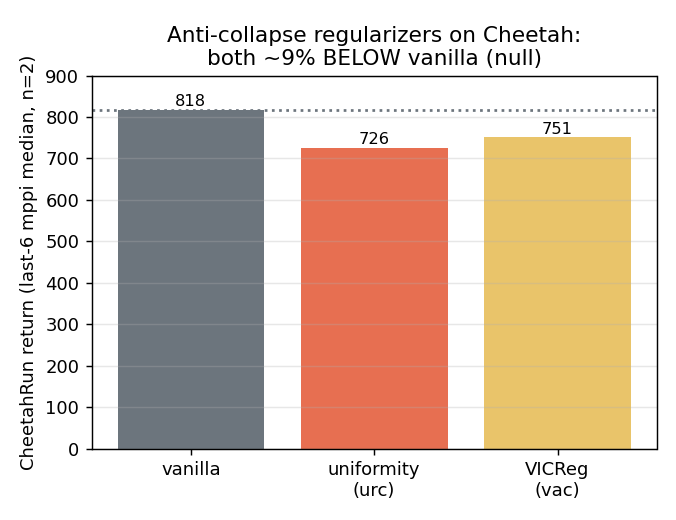
The anti-collapse (JEPA/SE) bets were parked since Part 7. This week I ran the two canonical levers on the task the VBN instrument flags as least compressible (CheetahRun): uniformity vs VICReg against a matched vanilla baseline.
What this actually is — not a JEPA (a reader flagged the naming). The
urc/vacarms are literallyuniformity_loss()andvicreg_loss()added as an auxiliary term to TD-MPC2’s existing latent (tdmpc2.py); with the coefficient at zero they reduce to vanilla. So this bounds “do anti-collapse penalties help a value-based world model?” — it is not a test of the JEPA architecture (a separate predictor over a decoder-free, EMA-target embedding). Plain JEPA/H-JEPA was never designed for DMControl value-control, and our earlier faithful H-JEPA runs (Panda, #55–58) nulled for a different reason (the low-level primitive). A proper “does a JEPA world model help on DMControl” test would adapt a modern JEPA-style controller — e.g. DINO-WM — rather than a penalty on TD-MPC2. Queued (issue #8). Until then I’ll call this the anti-collapse-regularizer result, not “JEPA.”
| arm | CheetahRun (last-6 median, n=2) | vs vanilla (~818) |
|---|---|---|
| uniformity (urc) | 725.8 | −11.3% |
| VICReg (vac) | 751.3 | −8.2% |
| vanilla | ~818 | — |
Uniformity ≈ VICReg, both below vanilla — a null, and the expected null under H-COMPRESS: TD-MPC2’s latent is already shaped by the value/TD objective, which prevents the collapse these regularizers exist to fight.
Update (07-15, live). A third Cheetah seed finished, taking this to n=3: uniformity 739 (−10%), VICReg 779 (−5%), still both below vanilla (~818) — the null holds. The WalkerRun boundary test (the most-compressible regime, where anti-collapse has the most room to help) is running now across a rented 4×4070 plus the freed 3060 box; at the interim ~2M/5M checkpoint all three arms are clustered ~695–724 with no separation yet — early-consistent with the null. If it stays null through 5M, H-COMPRESS is airtight across both VBN-fingerprint extremes. Final numbers next update.
But there is a caveat I want to state plainly, because it is the most interesting gap. “Anti-collapse regularizer” and “consistency loss” are only two points on the abstraction axis. They are not the richer abstraction machinery — SimNorm, the structural-entropy / glass latents, clustering / discretization, or behavioral abstractions like TAMP / skill-options. The redundancy claim, so far, is proven for anti-collapse + consistency; whether those other mechanisms are also redundant is an open, and separately testable, question. It is queued.
The world model as an abstraction (H-WM-ABSTRACT)
Here is the reframing this review is really driving at, and the reader’s question that prompted it: the consistency loss trains the world model, so is the world model a kind of abstraction? I think the promising hypothesis is yes — the latent-dynamics model is a learned, task-relevant compression, which is exactly what an abstraction is. Under that view:
- “Stripped vs full” is already an abstraction ablation — it ablates the learned abstraction (the world model) while leaving the planner.
- The SE/glass/SimNorm experiments are ablations of an imposed abstraction.
- The clean experiment is to cross them: ablate the imposed abstraction and the world model on the same grid, per task, so we can see which piece — imposed structure, learned dynamics, or the planner — is the working part. My current bet: on the flat-high tasks the working part is the value pathway and both abstractions are redundant; on the ramp/monotone tasks the learned world model carries real weight (that’s what the −24%/−44% strip costs say) while imposed structure still adds nothing.
That cross-ablation is the headline experiment queued below.
The one-line law, restated by hypothesis
H-COMPRESS: explicit structure is redundant exactly where the value objective already supplies what it would add. H-WM-ABSTRACT: the world model is itself a learned abstraction, and it is the abstraction that carries weight where the value code is not nearly-sufficient. Where neither holds, structure buys variance (H-VARIANCE), not a ceiling.
What’s queued (issues filed to the repo)
The review surfaced concrete gaps; each is now a tracked issue on SuuTTT/tdmpc-glass:
- Official-parity / dual-implementation test — run the same tasks on official TD-MPC2 vs our JAX reimplementation, matched-seed, to certify the reimplementation before the papers lean on it.
- VBN on HopperHop + head-by-head bottleneck — fill the missing fingerprint row and extend the bottleneck from the value head to the reward and dynamics heads.
- Do the other abstractions help? (SimNorm / SE-glass / clustering / TAMP) — the redundancy claim is currently only tested on anti-collapse + consistency; test the richer abstraction menu, guided by the VBN fingerprint (predict where each should help).
- World-model-as-abstraction cross-ablation (H-WM-ABSTRACT) — jointly ablate imposed abstraction and the learned world model per task, to isolate the working part.
- Deeper theory for task-conditional load-bearingness — formalize why the mean/variance ratio (and HopperHop’s conjunctive reward + exploration wall) makes some tasks removable-cell and others not.
Next
- Freeze compute on Papers A & 3, write. Both are data-complete at their final (n).
- The WalkerRun anti-collapse boundary sweep is running now across a rented 4×4070 plus the freed 3060 box; its verdict (null or not) closes the H-COMPRESS boundary.
- The H-WM-ABSTRACT cross-ablation is the first experiment of the new front.