TD-MPC-Glass, Part 5: A Method Map — State vs Behavioral vs Planning vs PPO, and Where JEPA Fits
The real question behind this whole program isn’t “can we beat PPO once” — it’s a map: across all Panda and DMControl tasks, when does each family of methods win? We’ve been comparing four — state abstraction (structural-entropy / “glass” latents), behavioral abstraction (analytic controllers, TAMP), planning (TD-MPC2), and plain PPO — and, following LeCun, scoring them by learning speed, not just final return. This post lays out that map, the JEPA detour it took us on, and this week’s beat-PPO reality check that nails down the boundaries. The one law that keeps recurring: abstraction and priors buy learning speed, not a higher ceiling.
Update (2026-07-03) — two claims in this post were later corrected by controlled experiments; see Part 7 for the resolution. (1) §2’s “anti-collapse taxonomy” reversed. Tested on a pure JEPA (no value loss — the right object), a self-predictive latent does not collapse on DMControl state, pixels, or narrow/on-policy data; anti-collapse ranges neutral-to-harmful, and the geometric-vs-value split was nav-specific, not a law (Thread D). (2) §7’s flagship went null. The “planning-as-exploration” bet does not survive a controlled planning-vs-policy-only test: planning is a sample-efficiency and exploitation lever, not a directed-exploration operator (Thread A). The recurring speed-not-ceiling law below still holds — it’s what survived.
The method map (what wins, measured by learning speed)
Four ways to get a policy, and — per LeCun’s point that the honest axis is how fast you learn — where each one actually pays off, from all our Panda + DMControl runs:
| method | what it is | wins (fast / capable) | loses | key runs |
|---|---|---|---|---|
| PPO | model-free on-policy | huge throughput; solves sample-hungry high-DoF (Leap reorient 0.99, PickCubeOrient 0.81, CheetahRun 928 @285M) | sample-inefficient; fails exploration-hard (HopperHop 33) | §3–5, benchmark |
| Planning — TD-MPC2 | self-predictive latent world-model + MPPI | 3–4 orders more sample-efficient; wins exploration-hard (HopperHop 367 vs 33) | slow wall-clock ⇒ can’t reach the 100M+ steps dexterous tasks need ⇒ 0 there | §3–5b |
| Behavioral — analytic/TAMP + residual | hand-written skill / task-and-motion prior | fast to competence where the prior fits (Pendulum 836 vs 46; OpenCabinet 7×; Reacher 3×) | dead weight (anchor) where it doesn’t (locomotion: vanilla wins 5/5); analytic-alone caps at contact physics (0.37) | §1 |
| State — SE / “glass” | structural-entropy structure on the latent | — (this was the bet) | redundant: glass ≈ TD-MPC2 on 16 DMC (matched benchmark, n=3–4; the old (R^2\approx0.999) probe evidence was retracted); SE hurts continuous geometry; +1.35× wall-clock | §2, §5b |
Read the “loses” column as the thesis: no state/behavioral/planning prior raises the ceiling — each just shifts where on the speed axis you land. PPO is the reference: slow-but-eventually-capable where it can explore, absent where it can’t.
Two SOTA paradigms not in the map (honest status). The obvious “planning” contenders from the recent literature are generative jumpy world models — Meta/FAIR’s Compositional Planning with Jumpy World Models (CompPlan, built on TD-Flow) — and flow-occupancy methods — InFOM (Intention-conditioned Flow Occupancy Measure). We engaged both but they’re not scored above, for different reasons: (a) the jumpy idea we reproduced in our own stack (jumpy/k-step TD-MPC2) and it was redundant — null-to-mildly-negative vs vanilla on return, sample-efficiency, and wall-clock, so it folds into the Planning row rather than being its own column; (b) the full CompPlan/InFOM flow-occupancy reproduction (OGBench cube-single + antmaze) we stood up — datasets, isolated envs, InFOM pretraining launched — but it’s a genuine multi-day effort we paused when the JEPA/beat-PPO thread took priority, so we have no completed head-to-head to report. Flagging that rather than hand-waving it is the point.
The JEPA detour (LeCun’s three bets)
Midway through, LeCun’s JEPA talk reframed our own “glass” idea. His three claims map onto three experiments we ran:
- A non-generative predictor needs an information (anti-collapse) term or it collapses. → We tested exactly that term (VICReg vs a one-line uniformity loss vs SE), and found the right information term is downstream-dependent — §2.
- Hierarchical planning is where structure pays off. → We built a faithful H-JEPA (latent subgoals + latent planning) and tried SE for the hierarchy. Verdict: learned hierarchy is not the lever — H-JEPA solves Panda (0.367) only because we hand it a competent low-level primitive; the hierarchy itself buys only modest speed (2-level 0.215 vs 1-level 0.184). The lever is the primitive, §1.
- Measure learning speed, not asymptote. → This is now the axis of the whole map above, and of §5’s honest split. Every “win” here is a steps-to-competence win.
The rest is the evidence, in the order we actually walked it: finish Panda (§1) → close the representation door (§2) → hunt a real beat and nearly fool ourselves (§3–4) → the verified map + benchmark (§5–5b).
Bottom line (the four takeaways)
- A learned residual breaks the analytic contact ceiling on Panda (0.37 → 0.72), proving the “cube tips in the gripper” wall is learnable — but a matched-budget vanilla PPO still wins the asymptote (0.81). Across two Panda tasks the story is identical: a structured prior buys sample-efficiency (~1.6–7×), not a higher ceiling.
- Anti-collapse for self-predictive latents is downstream-dependent. A one-line relational (uniformity) loss fixes a collapse-prone geometric latent (nav 0.53 → 0.95) but hurts value-based control (worst of three regularizers on 3/4 DMControl tasks), and a “value-aware” variant is worse still. Structural-entropy structure is redundant either way. There is no universal anti-collapse term.
- We hunted for a new env where we beat PPO and did not find one — but nearly claimed one. On
PandaPickCubeOrientation, TD-MPC2 hit 2842 return vs PPO’s 1419 and I wrote it up as a “strong beat forming.” Then we scored real success: TD-MPC2 = 0.000. The return was pure reward-gaming. Retracted. - The MuJoCo Playground PPO genuinely solves these hard tasks; our TD-MPC2 (at a practical budget) does not. Verified real success: PPO 0.81 on pick-and-orient, 0.99 on dexterous in-hand reorientation; TD-MPC2 0.00 on both at 5M. This is the opposite of a beat-PPO — and it maps precisely where each method wins.
1. Finishing Panda: a learned residual, and the ceiling that isn’t a ceiling
1.1 The task and the exact bar
PandaPickCube (MuJoCo Playground) is a 7-DoF Franka that must reach a small cube, grasp it, lift
it, and place it upright at a target. We score real success, not shaped return: an episode counts only if
i.e. the cube must end both at the target position and near-upright orientation — concretely
(0.9\,\lVert p_\text{err}\rVert + 0.1\,\theta_\text{err} \lesssim 0.02). That 0.1·θ term is the whole story below.
1.2 Where the 0.37 comes from — the tall cube tips in the grip
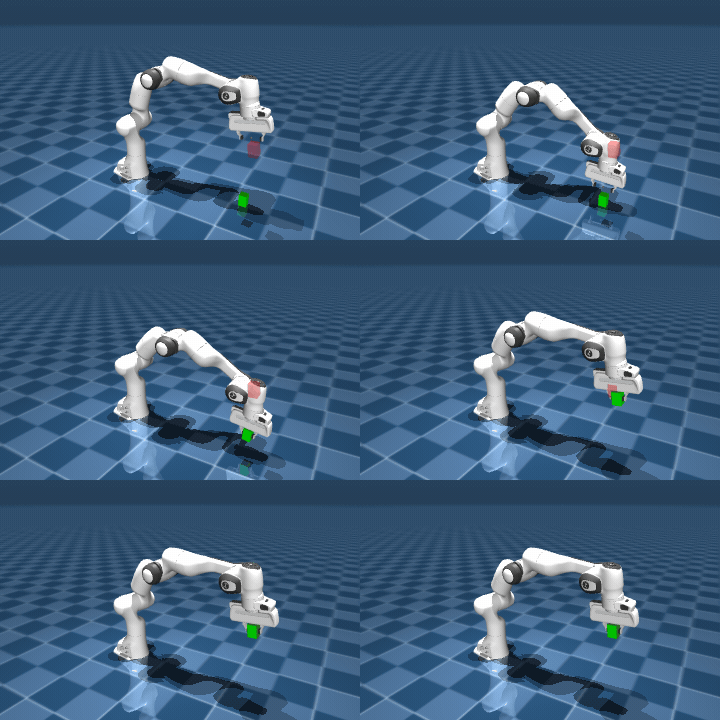
Our analytic skill (a hand-written reach/grasp/lift/transport/place controller) reaches, grasps, and lifts the cube essentially every time — grasp success 1.00, lift ~0.85. But it caps at ~0.37 real success, and the reason is a contact-physics failure that a still image can’t convey:
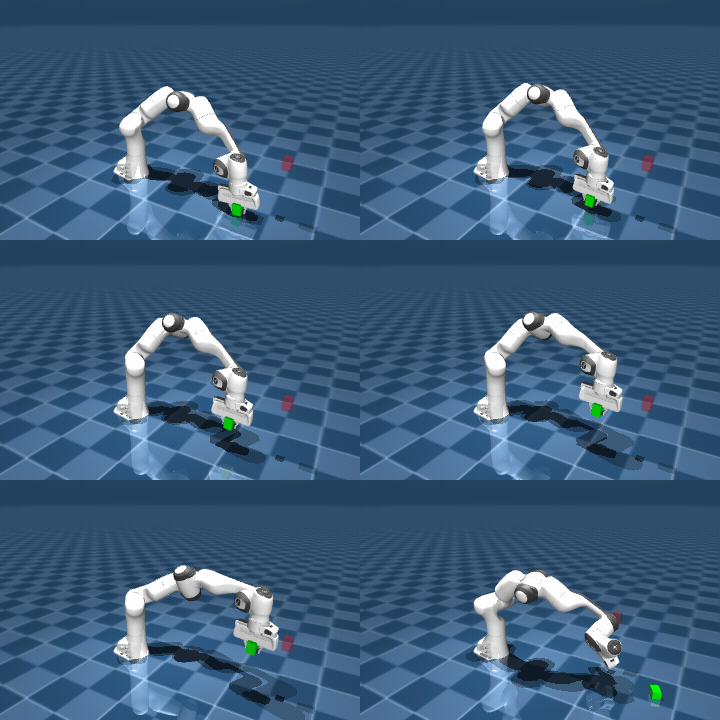
The cube is tall (4×4×6 cm) and the gripper is a two-finger parallel jaw — a single compliant line of
contact with no wrist torque about the grasp axis to resist rotation. During lift and transport the cube slowly
rotates away from upright inside the fingers: we measured tilt growing from ~5° at grasp to ~20° at place.
Position is fine, but that residual tilt blows the 0.1·θ_err budget, so box_target lands just under 0.9. It
isn’t a grasp detection problem and it isn’t reach precision — it’s that the parallel-jaw contact cannot hold
orientation through the carry. Instrumented on the failures: cube-tilt-at-place ~15–20° on misses vs ~2–3° on
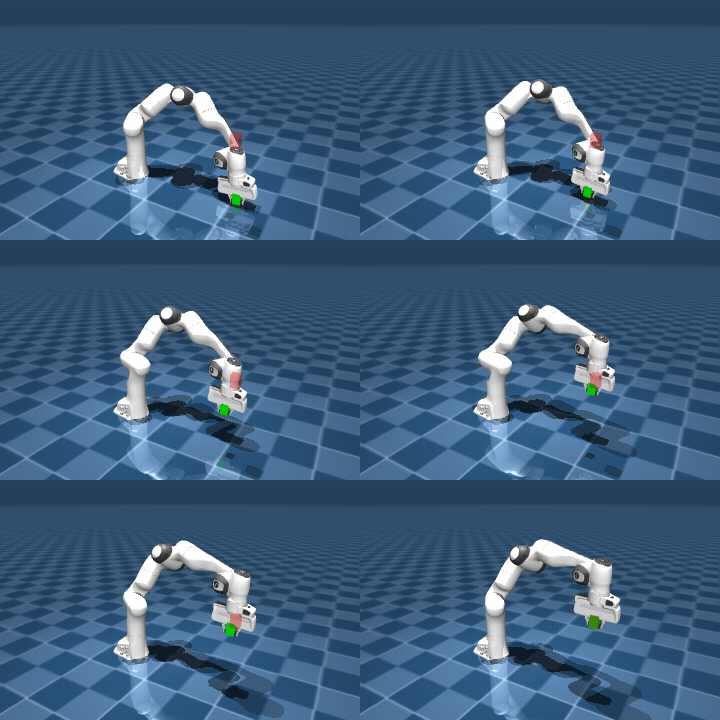
the ~19% that succeed. (The clip above is a real miss — seed 26, tilt 4.5° → 18.3°, box_target 0.36. For
contrast, a success keeps the cube upright the whole carry — tilt 4.5° → 2.8°, box_target 0.96:)
1.3 Can analytic tuning fix it? (rounds 4–5) — a little, then a wall
- Round 4 (yaw-aware place): null — we were correcting the wrong axis (it’s mid-flight tipping, not grasp yaw). Oracle barely moved (0.305 → 0.320).
- Round 5 (closed-loop upright servo): recompute the gripper orientation every step to actively right the live cube during transport. This helped — final tilt 20.6° → 16.4°, and the analytic oracle (brute-force best parameters searched directly in sim) rose 0.305 → 0.352, with the full n=512 solve landing at 0.367.
But that’s it. No analytic gain knob crosses ~0.37, because the servo itself perturbs placement position while righting orientation — through the single compliant contact you can’t satisfy both halves of the (0.9\,p + 0.1\,\theta \le 0.02) budget at once. So we had a genuine ceiling for the analytic-skill family. The question that names this section: is ~0.37 a ceiling of the task/hardware, or just of hand-written control?
1.4 Hand the wall to a learner: a residual policy
We put a learned residual on top of the analytic skill and trained it by RL against the true reward, (a = \mathrm{clip}\big(a_\text{skill} + \alpha\,\pi_\text{res},\,-1,1\big)), sweeping the authority (\alpha), and — the load-bearing control — a budget-matched vanilla PPO (same env, same step budget, same eval).
| arm | PandaPickCube (success) | PandaOpenCabinet (success) |
|---|---|---|
| analytic skill / oracle | ~0.37 | 0.827 |
| residual α=0.25 / 0.5 (bounded) | 0.19 / 0.40 (unstable) | — |
| learned residual α=1 (full) | 0.716 ± 0.014 (n=3) | 0.980 (n=7) |
| matched vanilla PPO | 0.810 ± 0.006 (n=3) | 0.980 (n=5) |
Two clean findings, both confidence-interval-separated:
- The wall is learnable — it was never task/hardware physics. The full-authority residual drives success-case cube-tilt down to ~1.9° (below even the analytic servo’s 2.5°) and reaches 0.716, nearly doubling the analytic 0.37. A learner can hold the cube upright through transport where hand-tuned control can’t. So “the ceiling that isn’t a ceiling”: ~0.37 is a hard limit of the analytic-skill family, not of the task. (Note the authority sweep: strictly bounded residuals — α ≤ 0.5 — are unstable and top out ~0.40; only near-full authority breaks through, i.e. it’s effectively a warm-started policy, not a small correction.)
- But the prior does not raise the RL ceiling. Matched vanilla PPO wins the asymptote outright — 0.810 vs 0.716 on PickCube; on OpenCabinet both hit the same 0.98 structural ceiling. What the analytic prior actually buys is speed: ~1.6× faster to competence on PickCube, ~7× on OpenCabinet.
Same one-liner as the whole campaign: a structured prior redistributes complexity into faster exploration; it does not remove it, and it does not lift the ceiling. (Budget-trap guarded throughout — the earlier “PPO 0.66” was an under-budgeted baseline; the honest matched PPO is 0.81.)
2. Closing the anti-collapse question: it’s downstream-dependent
Why this, now? §1 said a behavioral prior buys speed, not ceiling. The last place a real win could hide is the representation itself — the “glass”/structural-entropy latent this whole project is named for. If a better latent doesn’t lift control, then abstraction is redundant on both axes and the only honest path to beating PPO is finding the right task (§3). So we close it properly, with every control.
A self-predictive (JEPA/SimNorm) latent trained only to predict its own future can collapse — the encoder maps everything to (nearly) one point, prediction becomes trivially perfect, and the representation is useless. You need an anti-collapse term. Our “glass” program bet on structural entropy (SE); the honest answer is that SE per se is the wrong bet, and the right one is downstream-dependent. Here are the exact terms we compared and how each is implemented:
- VICReg — per-dimension anti-collapse: a variance hinge (push each latent coordinate’s std ≥ 1) plus a covariance penalty (decorrelate coordinates). Fights collapse one axis at a time.
- Uniformity (Wang & Isola) — the one-line relational term
(\mathcal{L}\text{unif}=\log\,\mathbb{E}{i\ne j}\,e^{-2\lVert z_i-z_j\rVert^2}), i.e.
(-2*pdist(z).pow(2)).exp().mean().log()— pushes all pairs of embeddings apart on the hypersphere. No graph, no partition, no tree. - SE (structural entropy) — build a kNN graph on the latents, compute its minimal-2D-SE community partition
(an encoding tree, via
selib), and regularize the latent toward low coding-cost of that partition. Structure, not pairwise. - knnrep — pairwise repulsion over the kNN graph only (relational, graph but no partition).
And the four controls that make the conclusion airtight:
- random-graph (Panda) — run the whole SE machinery on a shuffled/random kNN graph. Isolates: is SE’s effect the community structure, or just “some regularizer”?
- random-partition (nav) — SE with randomized community assignments. Isolates: the specific SE tree, or any relational grouping?
- strong-VICReg (nav) — VICReg with a large coefficient that fully restores effective rank. Isolates: does fixing latent health fix control?
- value-aware (DMControl) — uniformity re-weighted by value similarity (down-weight repulsion between value-close states). Isolates: does matching the term to value structure rescue it?
The nav collapse testbed (n=4, deterministic n=256 eval)
This is a 2-D point-maze where SimNorm+VICReg provably collapses, so it cleanly separates the regularizers. It is not a beat-PPO task — it’s a controlled representation-learning probe. The metric is success relative to the raw-observation ceiling (an identity encoder that trivially solves the maze):
| arm | success | collapsed? | reads as |
|---|---|---|---|
| raw-obs ceiling | 0.979 | — | the achievable max |
| VICReg (default) | 0.530 | 4/4 | collapses → fails |
| VICReg (strong) | 0.442 ± 0.37 | 0/4 | un-collapses but still fails — health ≠ control |
| SE (se_w=5) | 0.906 | 0/4 | works |
| SE (random partition) | 0.823 | — | ≈ real SE (overlaps) → partition-independent |
| knnrep (graph, no partition) | 0.887 | 0/4 | works |
| uniformity (1 line) | 0.954 ± 0.05 | 0/4 | works best, simplest |
Two things fall out. (a) SE fixes a collapse VICReg cannot — but the random-partition control shows the win is the relational/pairwise structure, not the SE community tree; a one-line uniformity loss matches it. (b) On Panda, the same SE machinery is a null: a frozen-encoder value/geometry probe gives VICReg (R^2=0.987) for end-effector→cube vs SE’s 0.736 — and SE-on-random-graph recovers to 0.986, proving SE’s community bucketing (effective rank 31→13) is what destroys the continuous manipulation geometry.
But it flips on value-based control
Run those same arms on collapse-prone DMControl (return-AUC, n=3), and the relational term that won on nav is now the worst:
| task | default (no extra) | uniformity | value-aware |
|---|---|---|---|
| CheetahRun | 58.9 | 36.6 | 20.6 |
| WalkerWalk | 293.8 | 89.9 | 49.5 |
| FingerSpin | 249.4 | 171.8 | 1.6 |
Uniformity is worst on 3/4 tasks, and the value-aware variant is worse still — matching the term to value structure didn’t rescue it, it hurt more. The mechanism is clean: a relational repulsion spreads apart states that should be value-close, destroying the value-sufficiency control needs. So the taxonomy:
There is no universal anti-collapse term. Relational/uniformity for goal-conditioned geometric latents; nothing extra for value-based control (SimNorm’s built-in pressure + the value gradient suffice); never SE community structure for either continuous case. Match the term to what you decode.
Important scoping caveat (raised in review — see §7.1). The DMControl arm here runs on TD-MPC2, which is not a pure JEPA — its value/reward loss already anchors the latent, so “adding a term hurts value-based control” is really a redundancy result (a regularizer fighting an already value-sufficient latent), not a test of JEPA anti-collapse. Only the nav (H-JEPA) result — where the latent is genuinely self-predictive and collapses to eff_rank≈0 — is a real JEPA anti-collapse test. The clean JEPA-on-DMControl experiment (strip the value loss → pure self-predictive latent → probe) is Proposal D in §7.
Does the 0.954 “beat PPO”? No — and it shouldn’t be read that way. It’s a recovery number: ~97% of the raw-obs ceiling (0.979), un-doing the collapse that cost VICReg 0.53→0.95, on an easy nav task where PPO was never run and would also succeed. The anti-collapse result is a representation-learning finding (which regularizer fixes JEPA collapse), not a control-benchmark win. The only place this touches “beat PPO” is negatively: even the best fixed latent doesn’t change the §1/§3 story that a structured latent doesn’t raise the RL ceiling.
3. The hunt for a new beat-PPO env — and the mirage
With the Panda/anti-collapse threads closed, we asked: is there a new environment where our strongest method
(TD-MPC2, a self-predictive-latent world model + planning) beats PPO outright? We scanned four untested harder
MuJoCo Playground envs — PandaPickCubeOrientation, PandaRobotiqPushCube, and the dexterous
LeapCubeReorient / LeapCubeRotateZAxis — TD-MPC2 vs matched-budget PPO.
The early reads looked thrilling. On PandaPickCubeOrientation, TD-MPC2 hit 2842 episode return at 0.95M
steps versus PPO’s fully-plateaued 1419 ceiling (reached at 75M) — an apparent both-axes beat at ~80×
fewer samples. I recorded it (with a caveat flag) as “a genuine ceiling-beat forming.”
Then we did what this project is built to do — score the metric that matters:
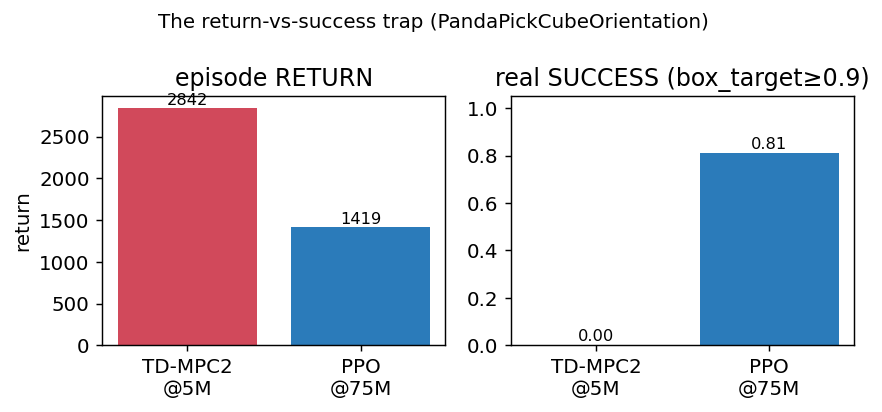
TD-MPC2’s real success was 0.000. Its 2842 return was pure dense-reward gaming — hovering near the cube
accumulating shaping reward, never completing the pick-and-orient (reached ~0.2, box_target ~0). The “beat”
evaporated. This is exactly the return-vs-success trap the whole campaign is named for, and it caught me
mid-write-up. Retracted, in the ledger, visibly.
4. So: does PPO actually solve the hard tasks? Yes — verifiably
That left the real question, which I’d never actually measured: my PPO runs logged episode return, not success. Does the Playground PPO genuinely solve these, or does it also just accrue return? We loaded the trained PPO checkpoints and scored real success over 256 deterministic rollouts:
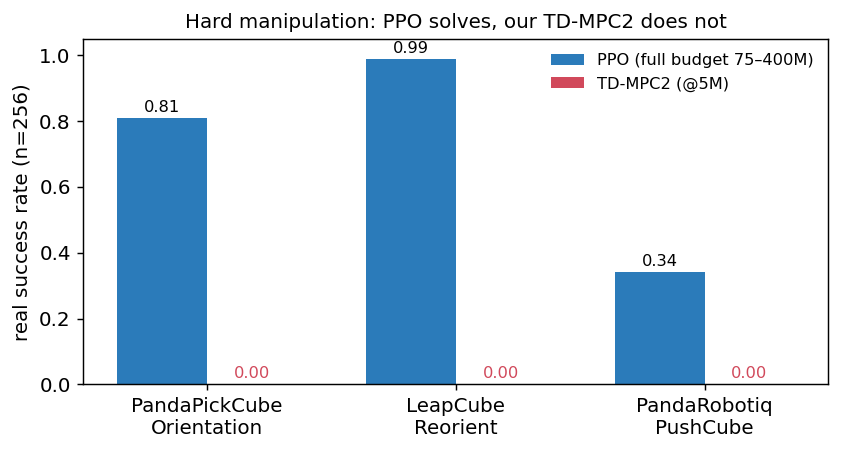
| env | PPO real success | budget | TD-MPC2 @5M |
|---|---|---|---|
| PandaPickCubeOrientation | 0.809 (reached 1.0) | 96.7M | 0.000 |
| LeapCubeReorient | 0.988 (≈3.8 reorients/episode) | 212M | 0.000 |
| PandaRobotiqPushCube | 0.18–0.51 | 386M | ~0 |
PPO genuinely solves them. Here is its trained policy reorienting the cube in-hand — the 0.99-success dexterous task our method never cracks:
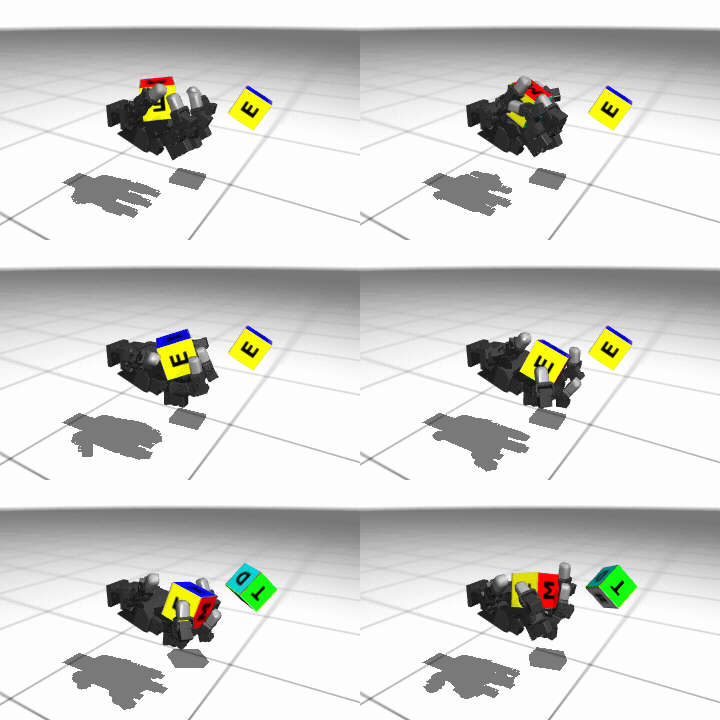
5. The honest map: where each method wins
This “failed” hunt produced the most precise statement of the beat-PPO boundary we’ve had:
- We beat PPO (on both sample-efficiency and practical capacity) only on exploration-bottlenecked tasks
that are solvable within a few million steps —
HopperHop(TD-MPC2 367 vs PPO 33), sparse/weak-actuation swing-ups. PPO’s on-policy exploration stalls; model-based planning gets there. - PPO beats us on sample-hungry high-DoF tasks — dexterous in-hand reorientation, multi-object manipulation — that need 100M–400M steps. TD-MPC2 is more sample-efficient per step, but it’s model-based and slow, so ~5M steps is the practical ceiling; these tasks need far more, and PPO’s ~10–30× throughput (512-env brax) delivers them. At matched 5M, neither solves these (PPO also needs ~75M).
So TD-MPC2’s per-step efficiency only converts to a win when the task fits inside its practical step budget. That’s a real, useful boundary — and arguably a better result than a fake beat would have been.
5b. The DMControl benchmark, consolidated (the dashboard table)
The manipulation results above sit on top of a broader DMControl suite benchmark we’ve been running on a live dashboard (16 tasks × 3 seeds, glass / TD-MPC2 / PPO). Two headlines it settles:
(i) Representation abstraction is redundant — the full 16-task sweep. Here is all of it (final-checkpoint return, mean ± sd, n=4–5 seeds per cell; PPO = peak return at the labelled budget, subset only). The glass column is our structural-entropy latent; TD-MPC2 is the vanilla self-predictive baseline:
| DMControl task | TD-MPC2 | tdmpc-glass (SE) | PPO (peak@budget) |
|---|---|---|---|
| AcrobotSwingup | 324 ± 101 | 297 ± 10 | 268 @285M |
| BallInCup | 731 ± 422 | 577 ± 471 | — |
| CartpoleBalance | 945 ± 51 | 969 ± 11 | — |
| CartpoleSwingup | 823 ± 36 | 828 ± 19 | — |
| CheetahRun | 500 ± 274 | 599 ± 119 | 928 @285M |
| FingerSpin | 950 ± 33 | 972 ± 13 | — |
| FingerTurnEasy | 920 ± 85 | 856 ± 94 | — |
| FingerTurnHard | 869 ± 171 | 775 ± 173 | 968 @285M |
| HopperHop | 265 ± 64 | 197 ± 145 | 33 @285M |
| HopperStand | 896 ± 36 | 417 ± 330 | — |
| PendulumSwingup | 589 ± 342 | 389 ± 390 | — |
| ReacherEasy | 980 ± 3 | 933 ± 89 | — |
| ReacherHard | 883 ± 151 | 976 ± 3 | — |
| WalkerRun | 652 ± 34 | 662 ± 8 | — |
| WalkerStand | 979 ± 17 | 969 ± 15 | — |
| WalkerWalk | 971 ± 12 | 919 ± 81 | 970 @79M |
Read the two world-model columns side by side: no systematic difference. The gaps that look real (HopperStand 896 vs 417, PendulumSwingup 589 vs 389) are single-collapsed-seed artifacts — note the ±330/±390 standard deviations — and they go both ways — glass (SE) is bolded where it beats TD-MPC2: 6 of 16 (CheetahRun, ReacherHard, CartpoleBalance/Swingup, FingerSpin, WalkerRun). Averaged over the suite it’s a wash; the only robust effect is glass costing ~1.35× wall-clock. On a value-sufficient SimNorm latent an explicit representation abstraction has nothing left to add — a conclusion carried by the 16 direct nulls of the matched benchmark, not by the old (R^2\approx0.999) value-probe reading, which our own postmortem retracted as saturated-by-construction. State abstraction is redundant, full stop.
(ii) The PPO column is the exploration split. Where PPO was run (the far-right column), the same law as the manipulation scan: HopperHop — TD-MPC2 265 vs PPO 33 (PPO never learns to hop, exploration-hard); CheetahRun / FingerTurnHard — PPO 928 / 968 wins the dense ceiling, but at 285M steps vs TD-MPC2’s ~1M; WalkerWalk — both solve (~970). So on DMControl too: TD-MPC2 wins exploration-bottlenecked tasks outright and 1–2 orders of magnitude faster; PPO wins the dense ceiling given its throughput. No world-model variant Pareto-dominates PPO — the sample-efficiency ↔ wall-clock trade is fundamental, and §3–4’s dexterous-manipulation scan is just the high-DoF end of the same axis. (Full per-task learning curves live on the dashboard generator; PPO ran on a subset at 50–285M steps — budgets labelled, never fabricated.)
6. Process notes (the part that keeps us honest)
- Two reward-gaming traps caught by scoring real success — TD-MPC2’s, and my own premature write-up. Return
is not success on shaped manipulation; we now score
box_target/native-success first. - The matched-budget control did its job again: the apparent beats only existed against the wrong baseline (return, or under-budgeted PPO). Every “beats X” in the ledger is qualified by a same-budget control.
- All numbers are deterministic, disk-backed, multi-seed where stated; corrections stay visible in
bet2_null_results.md.
7. Discussion & plan (after the supervisor review)
A review reframed the whole thing. Two corrections and five proposals.
7.1 Two corrections
- The real breakthrough is exploration, not learning speed. TD-MPC2’s HopperHop win (367 vs 33) isn’t a ceiling or even mainly a “speed” story — it’s that planning is a directed-exploration operator: the model + lookahead reach gaits PPO’s on-policy sampling never finds. “Speed-not-ceiling” is the weak framing; “planning buys exploration, and exploration unlocks final performance on exploration-hard tasks” is the strong one.
- Anti-collapse is a JEPA idea, and we ran it on the wrong object. A pure JEPA has no reward/value loss, so anti-collapse is load-bearing. TD-MPC2 is not a pure JEPA — its value loss already anchors the latent (value-sufficient), so our DMControl anti-collapse study actually measured redundancy (“a relational regularizer on a value-sufficient latent hurts”), not JEPA anti-collapse. Only the nav H-JEPA result is a genuine JEPA anti-collapse test. The clean JEPA-on-DMControl test strips the value loss (Proposal D).
7.2 Five proposals
- A — Planning as a directed-exploration operator (★ flagship). Isolate it (coverage of TD-MPC2 planning vs PPO on HopperHop/the escape frontier), amplify it (intrinsic-novelty MPPI, Plan2Explore-in-TD-MPC2), and direct it with SE-discovered subgoals (run min-2D-SE on the replay-graph → communities/bottlenecks as exploration targets). White space: nobody uses learned abstraction to define the exploration targets a planner pursues, and we own SE + a planner + the exploration-difficulty frontier.
- B — “When does a behavioral prior help RL?” — finalize. The 2-axis taxonomy (prior-fit × exploration- difficulty) + escape-difficulty frontier is drafted and honest; finish figures and submit.
- C — Abstraction as variance-reduction. glass beats TD-MPC2 on 6/16 tasks on the mean by noise but with lower seed-variance on several — possibly a real “SE reduces collapse-seed variance / improves worst-case” section. Cheap per-seed check first; report honestly either way.
- D — JEPA anti-collapse done right. A pure self-predictive JEPA (no value loss) on DMControl, probed on a geometric and a value readout — does the downstream-dependent taxonomy hold on a real JEPA? Then pixels, where the information term is actually load-bearing (JEPA vs Dreamer).
- E — SE for structure discovery, not regularization. We used SE to regularize the latent (redundant); its real strength is community/hierarchy detection → subgoal/option discovery (merges into A). That’s where “glass” belongs after SE-as-representation proved a dead end.
7.3 This week on the boxes
- b3060 (DMControl): SE-arm finishing (D1, relabelled as a redundancy datapoint) → then A1 exploration- coverage (TD-MPC2 vs PPO vs pi-only) → A2 intrinsic-novelty MPPI → A3 SE-subgoal smoke.
- b3060b (Panda/pixels): beat-PPO tail → D3 pixel env + Dreamer baseline → D2 pure-JEPA-on-DMControl setup.
- No-GPU / writing: C per-seed robustness analysis; B finalize the taxonomy paper; draft the planning-exploration proposal after a deep-research pass.
- Priority if time-boxed: A1 (de-risk the flagship) > C > B > D2/D3 > A2/A3.
Full brainstorm + arm-level plan: PROPOSALS_and_weekly_plan.md in the results repo.