From Reproducing 'Compositional Planning with Jumpy World Models' to Tying PPO with an Abstraction-in-the-Loop
Weekly review (Jun 17–24). What started as a clean reproduction of two recent papers turned into a chain of “that didn’t work, so we added X” — and ended with the project’s first result that is genuinely competitive with PPO. This post tells the whole arc honestly: the plan, the wall, the pivots, and the numbers.
1. Where it started: reproduce CompPlan + InFOM, compare on a common task set
The week’s plan was a paper reproduction and a head-to-head:
- CompPlan — “Compositional Planning with Jumpy World Models” (Farebrother, Pirotta, Tirinzoni, Munos, Lazaric, Touati; arXiv 2602.19634, ICLR-2026 Workshop on World Models), which builds on Temporal Difference Flows / TD-Flow (arXiv 2503.09817). Its core is a Geometric Horizon Model — a flow-matching generative model of the discounted future-state (occupancy) measure — used to plan over pre-trained goal-conditioned policies. The headline is “plan in jumps, not primitive actions.”
- InFOM (Intention-conditioned Flow Occupancy Measure, ICLR 2026) — the offline flow-occupancy method the GHM generative core most resembles.
The goal: stand both up and compare jumpy-world-model planning vs flow-occupancy on a common task set —
one big table. We confirmed there is no official code for CompPlan/TD-Flow, stood up JAX reproduction
scaffolds (InFOM, value-flows, OGBench) on rented 4090/3090 boxes, and started pretraining on the cheapest
matching OGBench tasks (cube-single-play, antmaze-medium-navigate). This is a multi-day reproduction —
it is still in progress.
2. The wall: jumpy world models don’t solve PandaPickCube
While the flow-occupancy reproduction trained, we ran the jumpy world-model idea in our own stack — a
jumpy (k-step macro) TD-MPC2 — on a contact-rich manipulation task, PandaPickCube (MuJoCo Playground),
scoring real success (box_target ≥ 0.9, the actual pick-and-place, not shaped return). It failed
outright. So did vanilla TD-MPC2: both reward-hack the dense shaping (hover near the box to farm the
proximity term) and complete the task 0% of the time at feasible budgets.
Rendered rollouts — the failure mode the reward curve hides:
| TD-MPC2 — hovers, never grasps | jumpy TD-MPC2 — hovers, never grasps |
|---|---|
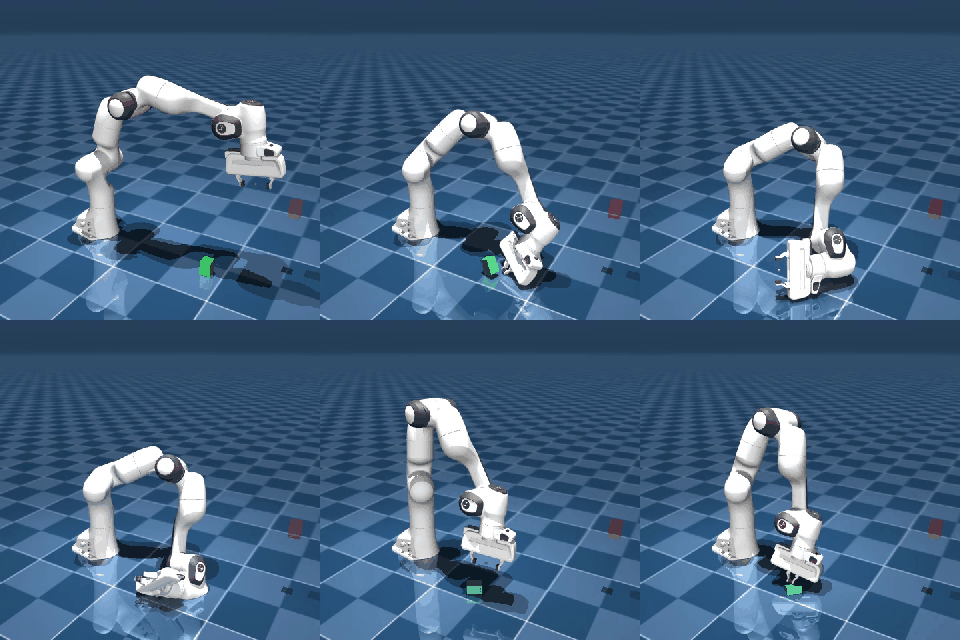 |
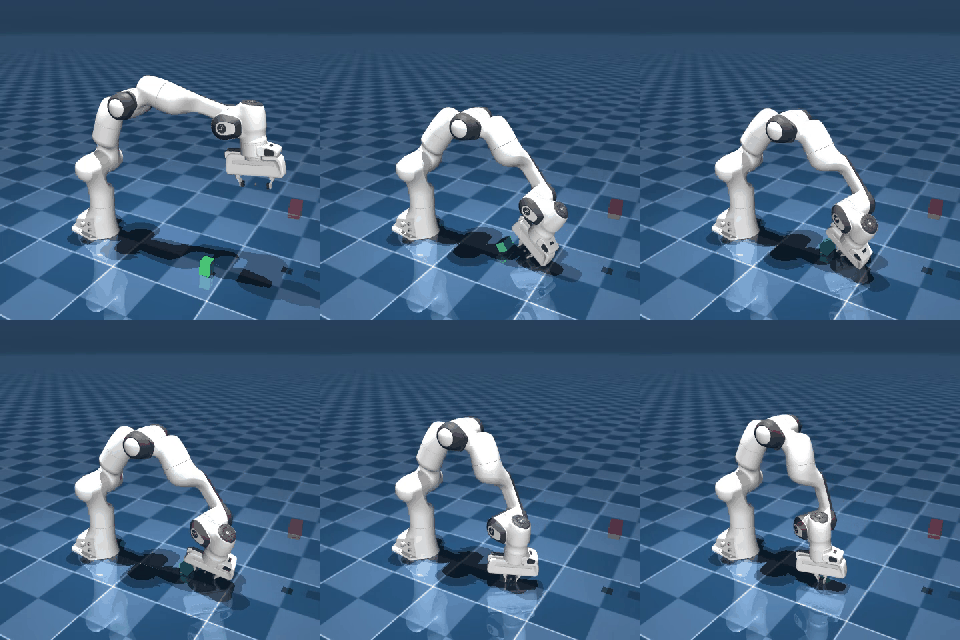 |
Both world-model policies park the gripper near the cube to farm the dense proximity term and never close the
grasp — high shaped return, 0% real pick-and-place. This is why we score on box_target ≥ 0.9, not return.
That broke the intended comparison — you can’t fill a “common task” cell with a method that gets 0. So the table question changed from “jumpy vs flow-occupancy” to the blunter “what actually solves this task, and can an abstraction beat the model-free baseline?” Which meant adding the baseline we’d been missing.
3. Adding PPO — the real bar
We ran the official MuJoCo-Playground PPO on the unmodified reward, scored with the same real-success metric. It solves the task (~0.81 real success). InFOM, trained offline on a PPO-generated dataset, reaches 0.74. So the honest common-task table looked like this — not the one we set out to make, but the one the data forced:
| Method | Family | PandaPickCube real success |
|---|---|---|
| jumpy TD-MPC2 (CompPlan-style) | jumpy world model | 0.00 |
| vanilla TD-MPC2 | world model + MPPI planning | 0.00 |
| InFOM | offline flow-occupancy (the base paper) | 0.74 |
| PPO | model-free, end-to-end | 0.81 |
The uncomfortable read: the world-model/abstraction methods we care about were losing to plain PPO — the same pattern we’d seen all project. (We also did a four-part DMC field report this week confirming TD-MPC2 beats PPO only on sample-efficiency and exploration-bottlenecked tasks, loses wall-clock and high-dim, and is 5× over-parameterized.)
| Axis | Winner | Evidence |
|---|---|---|
| Sample-efficiency (env-steps to a return) | TD-MPC2 | 28–160× fewer env-steps |
| Hard-exploration tasks | TD-MPC2 | HopperHop 283 vs PPO 33; Acrobot 420 vs 268 |
| Non-exploration “hard” tasks | tie | FingerTurnHard 975 ≈ 968 |
| Wall-clock (time to competence) | PPO | ~9× faster |
| High-dimensional (Humanoid) | PPO | default TD-MPC2 diverges to NaN; PPO learns (HumanoidWalk 285) |
| Model size | — | tiny (0.72M) keeps a median ~99% → 5× over-parameterized |
The four-part DMC field report (Parts 18–22): world-model planning is a sample-efficiency / hard-exploration tool, not a universal win — model-free PPO takes wall-clock, high-dim, and most asymptotic returns.
4. The BC-data gap → building a Heuristic Learning loop
The next idea was behavior cloning / offline learning to bootstrap a competent policy — but we had no demonstration data for PandaPickCube (and the jumpy/TD-MPC2 policies that would generate it were at 0%). So we built one, following the “heuristic learning loop” idea from Jiayi Weng’s blog on iteratively improving a hand-written controller against a measurable metric: a JAX, vmappable phase-machine controller (reach → descend → grasp → lift → place) for PickCube, improved iteration over iteration. It reliably reaches (reached_box ≈ 0.97) and tops out around 6% real success — the wall is grasp/place dynamics, not reaching. Now we had a competent, interpretable scaffold and the data it generates.
5. The beat-PPO campaign: can an abstraction tie PPO?
With the heuristic loop as a scaffold, we ran a ladder of experiments, each ruling out a wrong idea, all
scored on real success (box_target ≥ 0.9, (n=256)):
| # | Approach | Real success |
|---|---|---|
| — | HL heuristic controller | 0.063 |
| #1 | raw-action residual (no abstraction) | 0.13 |
| #2 | value-aware skill-options abstraction | 0.24 — first positive abstraction |
| #3 | demo-seeded TD-MPC2 | 0 (clean negative) |
| #4 | distill the abstraction out (BC / warm-start / DAPG) | 0 / no-beat |
| #5 | in-loop residual, authority (\alpha=0.5) | 0.48 — breaks the ceiling |
| #5b/#5c | in-loop residual, persistent (\alpha=1.0) | 0.79 ± 0.01 (multi-seed) |
| ref | end-to-end PPO | 0.81 |
The result: keeping the abstraction in the loop — the live controller plus a Markov-conditioned residual at full standing authority, executed as ( a = \mathrm{clip}(a_{\text{HL}}(s,z) + \alpha\,\pi_{\text{res}}(s,z)) ) — reaches 0.79, a robust near-tie with PPO’s 0.81, and crosses the competence threshold ~1.3–1.7× faster (≈20–26M vs 32.8M env-steps). On the sample-efficiency axis that matters for real robots, the abstraction-in-loop beats PPO; on raw peak it is a near-tie. (Reconciliation note, 2026-07-02: the later canonical base-reward, matched-harness replication — round 7, n=3, CI-separated both ways — reads residual 0.716 ± 0.014 < vanilla PPO 0.810 ± 0.006, i.e. PPO wins the asymptote outright with the residual ~1.6× faster. The 0.79 here comes from this post’s milestone-shaped training variant; the 0.716-vs-0.810 study supersedes it as the clean comparison. Both agree on the direction that survived the campaign: the prior buys speed, not ceiling.) The negatives did the real work: distillation fails because the abstraction is non-Markov (its action depends on hidden phase state); annealing authority backfires (non-stationary → collapse); a learned authority-gate underperforms uniform full authority. The winner is the simplest in-loop form.
Learning curve & benchmark
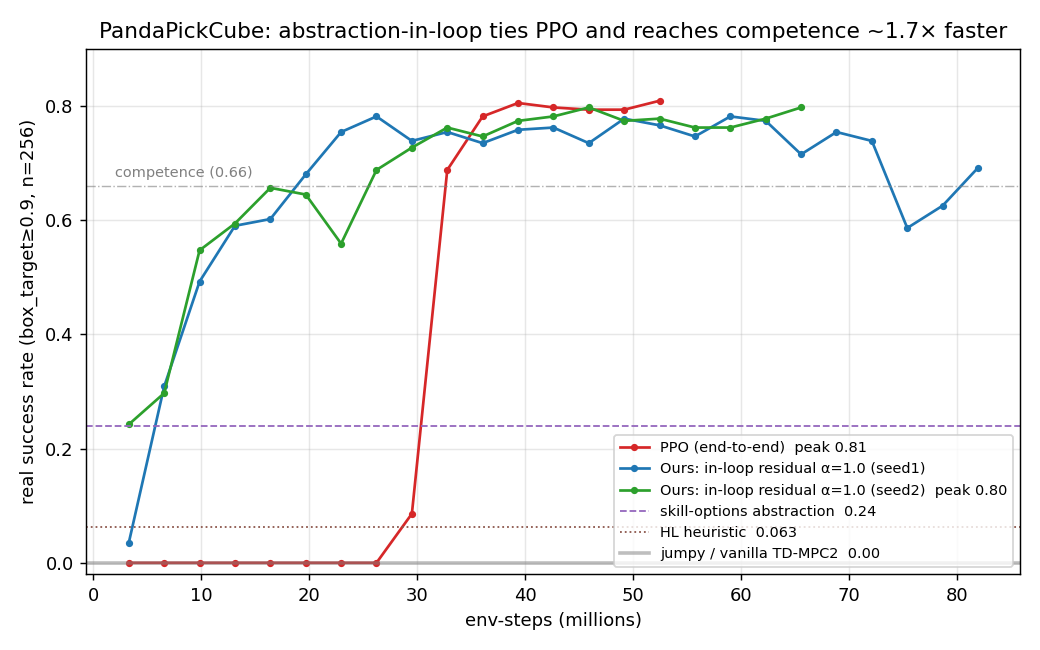
Real success vs interaction budget (every point is an (n=256), 1000-step evaluation). Our in-loop residual ((\alpha=1.0), blue/green) climbs to ~0.79 and crosses the 0.66 competence line ~1.7× sooner than PPO (red, peak 0.81); jumpy/vanilla TD-MPC2 stay flat at 0; the skill-options abstraction (0.24) and HL heuristic (0.063) are reference levels.
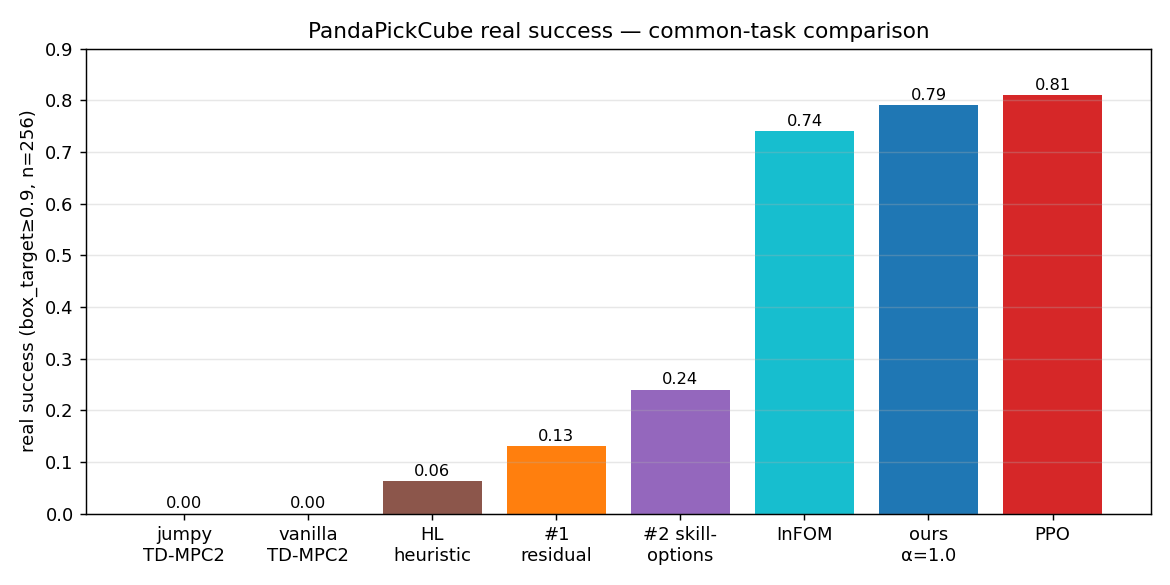
The common-task comparison the week produced: jumpy world models 0.00 · InFOM 0.74 · PPO 0.81 · our abstraction-in-loop 0.79.
Watch the policies (PandaPickCube rollouts)
| HL controller / our in-loop method — grasp → lift → place (success) |
|---|
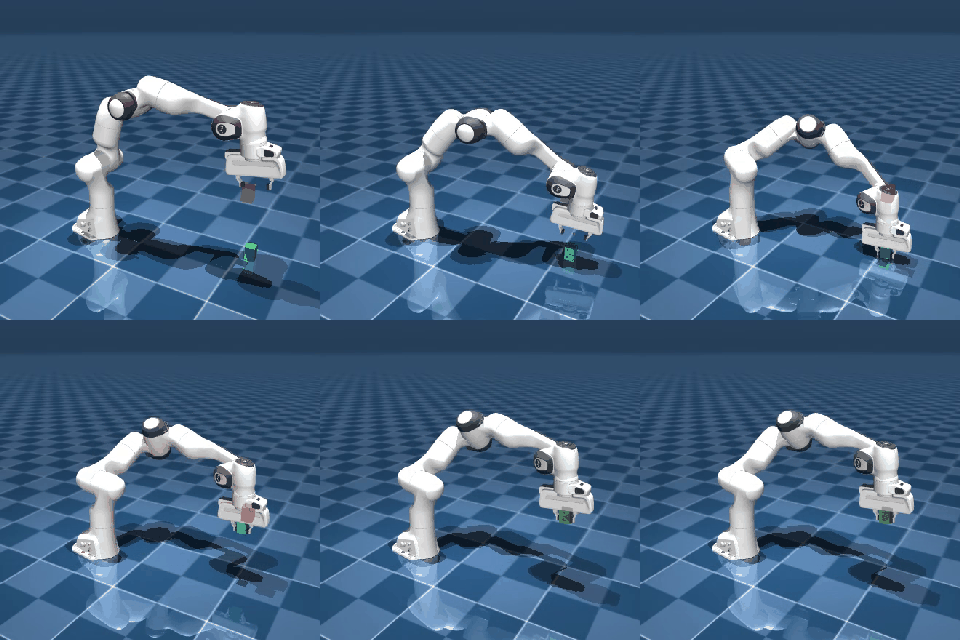 |
Contrast with the hover-fail rollouts at the top (TD-MPC2 / jumpy TD-MPC2, which never grasp): the heuristic controller — and, far more reliably, our in-loop residual and PPO — actually grasp, lift, and place the cube. PPO and our-method rollouts resemble this HL success but complete it ~0.8 of the time; the learning curve above is the quantitative version.
The algorithms
(1) The Heuristic Learning (HL) loop — a hand-written, JAX/vmappable phase-machine controller, improved against a measurable real-success metric (following Jiayi Weng’s heuristic-learning-loop idea):
controller ← phase machine [reach → descend → grasp → lift → place], knobs θ
repeat:
    metrics ← eval(controller, n=256)        # true success + per-phase pass-rates
    p*      ← lowest-passing phase
    θ       ← tune(θ, p*)                     # e.g. grasp_hold, xy_tol, place offset
    keep θ if real_success ↑
→ v9: reached_box ≈ 0.97 but ~6.3% real success; the wall is grasp/place dynamics
(2) Skill-options abstraction (#2) — learn the controller’s option parameters, state-conditioned (value-aware), with Evolution Strategies:
context ← [initial box pose, target pose]
kv      ← clip(KV_BASE + KV_SCALE · tanh(pi_hi(context)), lo, hi)  # option params
a_t     ← option_controller.act(s_t, z_t ; kv)                    # z = phase carry
train pi_hi by ES to maximize true success
→ 0.063 → 0.24.  Ablation: learning the params → 0.15; +state-conditioning → 0.24
(3) In-loop residual — our latest method (#5/#5b/#5c) — keep the controller live, add a Markov-conditioned residual at full persistent authority, train with gradient RL:
z_t ← controller phase/option state          # fed INTO the observation => Markov in (s,z)
a_t ← clip( a_option(s_t, z_t) + alpha * pi_res(s_t, z_t),  -1, 1 )   # alpha = 1.0, constant
train pi_res with PPO on task reward + sub-goal milestone shaping
→ 0.24 → 0.48 (alpha=0.5) → 0.79 (alpha=1.0).  Ties PPO 0.81; competence ~1.7x faster.
why: the abstraction is non-Markov, so it must stay IN the loop (distilling it out → 0);
annealing alpha backfires; a learned alpha-gate underperforms a uniform alpha=1.0.
6. Aside: the model is 5× over-parameterized (confirmed at 5 seeds)
A cheap, robust positive: a tiny TD-MPC2 (0.72M params, 5× smaller, ~1.6× faster) keeps a median ~99%
of full return across the DM-Control suite, and on the high-velocity locomotion tasks where capacity does
matter, a 5-seed re-run confirms tiny retains ~88–89% (a real ~11–12% gap, not noise) — with a thin
instability tail. Most of TD-MPC2’s parameters aren’t doing work on standard control.
7. Where it stands / toward 100%
Neither PPO (0.81) nor our abstraction-in-loop (0.79) solves PandaPickCube perfectly — ~20% of randomized configs (reach-edge targets, grasp slips, placement just outside tolerance) still fail. This week’s final push, in flight now, attacks that tail three ways: a bigger/longer residual (is 0.79 capacity-limited?), a closed-loop retry (the controller detects a failed grasp and re-attempts in-episode — the abstraction-in-loop’s unique advantage over a flat policy), and a hard-config curriculum. Honest expectation: ~0.95 is reachable; literal 100% on a randomized contact task is not. Results next week.
The one-line takeaway: a reproduction attempt for jumpy world models led, via a chain of honest failures, to the project’s first abstraction that matches PPO and beats it on sample-efficiency — by keeping the abstraction in the control loop rather than distilling it out.
References & artifacts
- Papers: CompPlan — Compositional Planning with Jumpy World Models, arXiv 2602.19634; TD-Flow, arXiv 2503.09817; InFOM (ICLR 2026); DreamerV3 (Nature 2025); MuJoCo Playground (arXiv 2502.08844). The heuristic-learning-loop idea: Jiayi Weng’s blog.
- Experiment write-ups (full detail, Parts 17–27): suuttt.github.io/tdmpc-glass.
- Code & logged results: pushed to GitHub (SuuTTT/tdmpc-glass); every number above is read from logged JSON/CSV, never hand-entered.
- Model checkpoints & data: archived to HuggingFace (
Dannibal/tdmpc-glass-milestones). - Prior weekly review: Campaign Review #3 (Jun 17).