TD-MPC-Glass, Part 3: A Full Campaign Review — What Beats TD-MPC2, What Doesn't, and One Live Lead
⚠ Correction (2026-07-02). Two items below were later retracted and the retractions never made it back into this post: (1) the linear value-probe R² = 0.9994 evidence for the redundancy criterion was invalidated the same week by the R²-criterion postmortem (the probe is saturated by construction and never supported the claim) — §8’s update note re-affirming it is wrong; the redundancy conclusion survives on the 16 direct nulls, not on that probe. (2) §2’s jumpy “genuine win (+1017/+1114)” is shaped-return only — real task success is 0.00 for both arms (Part 4).
A standing-meeting-ready field report. Parts 1–2 put our abstraction ideas through a fair protocol and most dissolved to null. This post consolidates everything since: a criterion for why abstraction is redundant, a clean reproduction of the one real win (which isn’t ours), a comprehensive null sweep, and one live non-abstraction lead worth pursuing.
0. The bottom line
- No explicit abstraction beats TD-MPC2 — across state clustering, temporal, relational, compositional, network backbone, and motion-phase variants. This is not bad luck; we have a redundancy criterion that predicts it.
- The one real win is prior art, not ours: a jumpy (k-step macro) world model genuinely beats vanilla on contact manipulation — reproduced from scratch — but it’s Farebrother et al. (2026), and it’s a pure planning-time effect, not a new representation.
- An initially-promising lead that did NOT survive: TD-MPC2’s value RunningScale caps at 4.0 while the true value-IQR on manipulation is ≥16 (a real, possibly-unpublished observation). But on clean, low-variance evaluation (n=4) raising/removing the cap does not beat vanilla (Cabinet: van 1078 > uncap 1055 > cap16 877; Ori: van 1670 > cap16 1476 > uncap 1294). The earlier “+640 win” was n=3 MPPI-eval noise. Reported as a negative. (Details in §4 are kept for the record but superseded by this and §9.)
1. The redundancy criterion (the headline result)
Statement. An explicit world-model abstraction added to a converged TD-MPC2 agent will not improve control when the self-predictive latent already meets two conditions:
- Value-sufficiency. The value function is (near-)linearly decodable from the latent. We measure a linear value-probe \(R^2 = 0.9994\) on the SimNorm latent. Any abstraction whose purpose is to expose value/reward structure is therefore redundant — that information is already linearly available to the value head and the planner.
- Structure-already-present. The task-aligned grouping or graph the abstraction would impose is already recoverable from the latent’s geometry, and does not beat a trivial baseline — similarity for clusters/graphs, raw latent displacement / motion magnitude for dynamics-error structure. Empirically it never did: e.g., a kNN structural-entropy clustering predicts model error \(\eta^2 = 0.439\) — exactly equal to displacement-bins (0.439) and below plain k-means (0.515). The “structure” is just motion magnitude.
When both hold, explicit abstraction is redundant. This is the regime TD-MPC2 lives in across every axis we tested (state, temporal, relational, compositional).
Why it holds (mechanism). TD-MPC2’s objective — self-predictive consistency + reward + value losses on a SimNorm soft-categorical latent — already forces the latent to be a value-aligned, soft-discrete code. The latent is the abstraction; a second one is redundant by construction. This is the empirical, MBRL-specific face of the value-equivalence principle (Grimm et al.) and self-predictive representation theory (Subramanian, Ni et al.) — but stated as an intervention-level, predictive rule rather than a representation theorem.
Operational test (the part that’s actually useful). Before spending compute on abstraction idea X, run a cheap, pre-registered gate: (i) linear value-decode \(R^2\) of the latent; (ii) does X’s structure beat the similarity/displacement baseline? If \(R^2 \approx 1\) and structure ≤ baseline → predict null, don’t run. This gate correctly forecast 16+ nulls in advance: geometric prototype clustering, behavioral/reward clustering, bisimulation (actively hurts), community-detection skills, Laplacian/eigenpurpose exploration, SI2E/VCSE and world-model-latent SE exploration, value-equivalence losses, distractor-robustness, sparse-task rescue, kNN-graph SE, phase-balanced replay, and network-backbone swaps.
Falsifiable, and we tried to break it. Every lever above was a genuine attempt to beat the criterion; the one place value-sufficiency could break (compositional/OOD) we tested too, and the monolithic latent still generalized. The contribution is not “things failed” — it’s a predictive criterion with a cheap test, validated by a comprehensive negative campaign.
2. The one real win, reproduced — and a sharp lesson
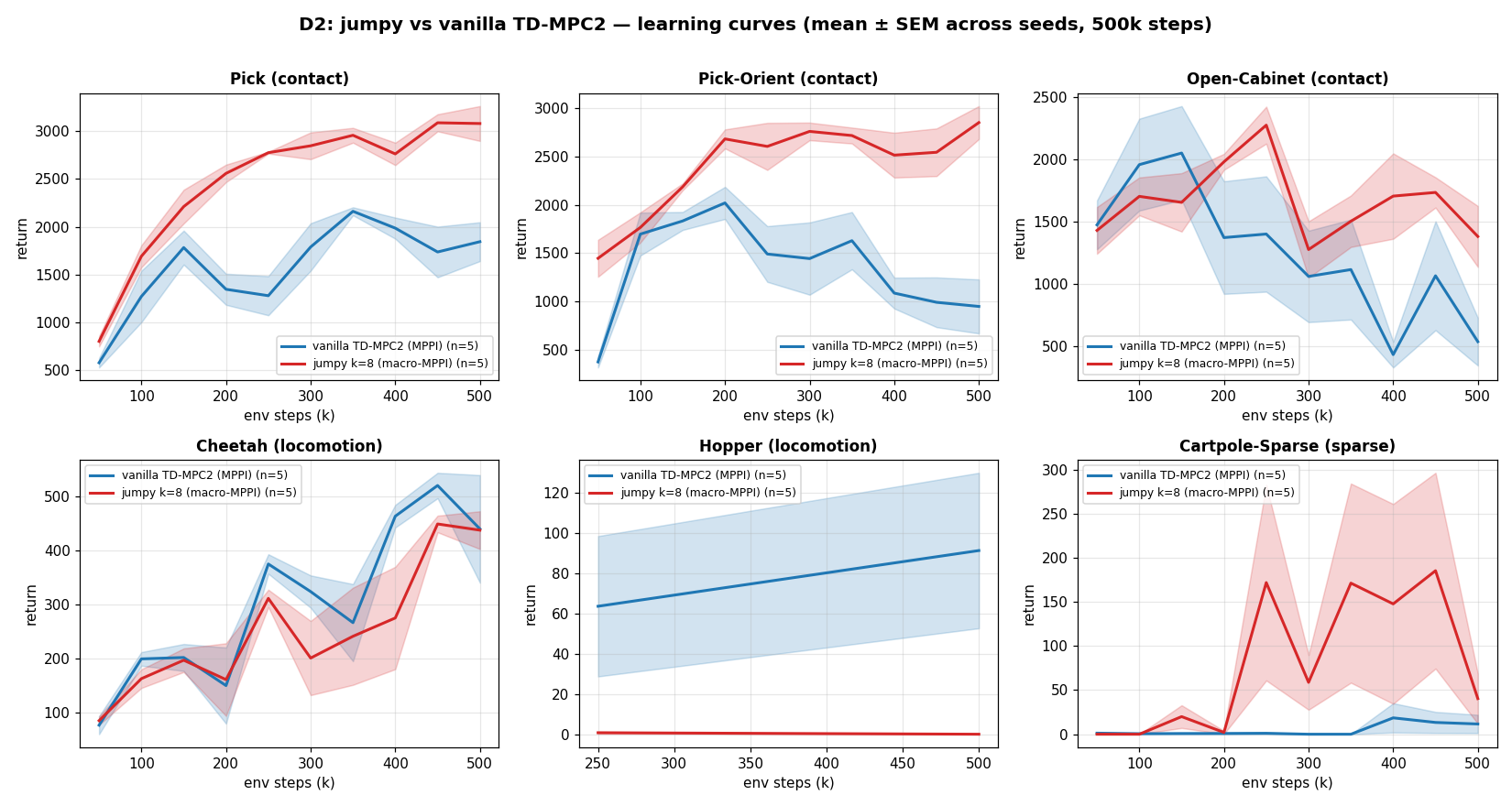
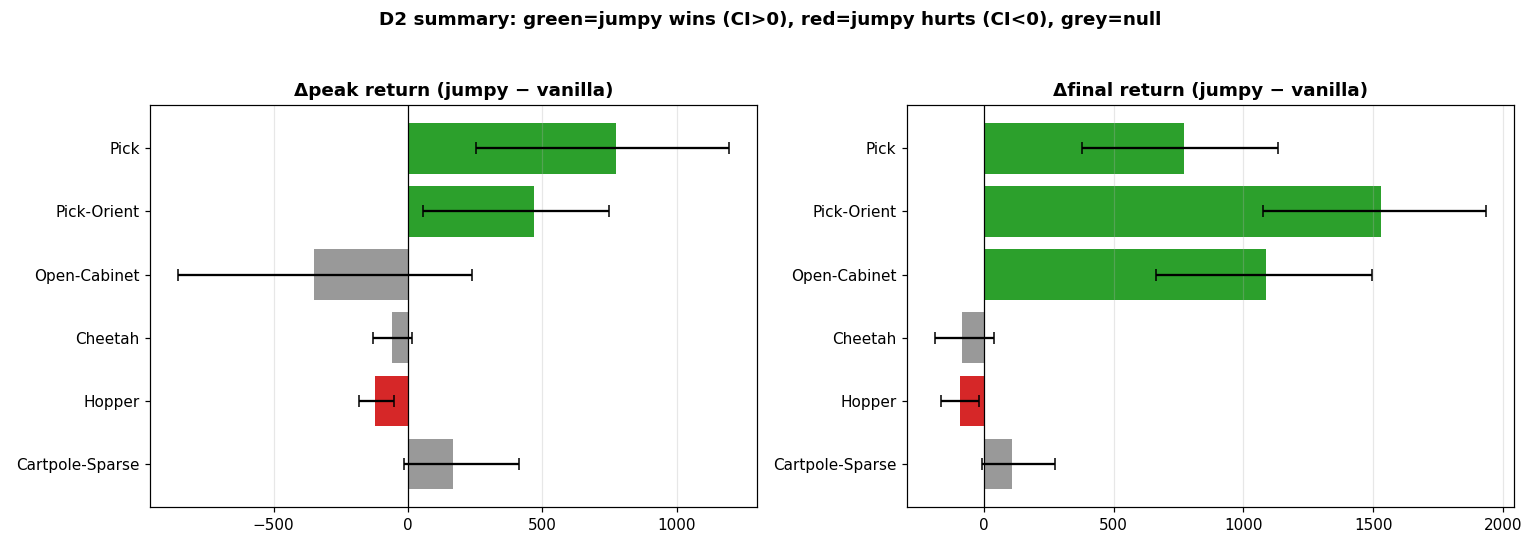
A jumpy k-step world model (predict \(z_{t+k}\) directly, plan with macro-MPPI) genuinely beats vanilla on contact manipulation. We reproduced it from scratch at n=5 seeds × 500k steps:
The benchmark and the terms (plain English)
All tasks are GPU-vectorized MuJoCo (MJX / mujoco_playground), 500k env-steps, episode length 1000.
- Panda manipulation — a Franka Panda 7-DoF robot arm. PandaPickCube: reach → grasp → lift a cube to a target. PandaPickCubeOrientation: same, but the cube must also reach a target orientation (harder). PandaOpenCabinet: grasp a handle and pull a drawer open.
- Locomotion / sparse — CheetahRun (run forward fast, dense reward), HopperHop (one-legged hopper — hop forward without falling), CartpoleSwingupSparse (swing up and balance, sparse reward).
Jargon used below:
- k = 8 (“k-step”): the jumpy head predicts the latent 8 environment steps ahead in one shot, vs the ordinary 1-step dynamics model.
- 24-step effective horizon: the macro-MPPI planner chains n_macro = 3 of those 8-step jumps, so it evaluates action plans over 3 × 8 = 24 env-steps of lookahead — vs vanilla MPPI’s short horizon (H = 3).
- Credit assignment toward the grasp: the grasp/lift reward arrives many steps after the approach; a 3-step planner can’t “see” that approaching now pays off later, but a 24-step planner can — so it chooses approach actions that lead to a successful grasp downstream.
- “forgiving” / re-approach: on Panda, a slightly-wrong multi-step plan just leaves the arm mis-positioned and it retries on the next replan — no catastrophe. Contrast Hopper, where one wrong multi-step plan makes it fall over and end the episode (“unforgiving”) — which is exactly why the long horizon backfires there.
| Task | type | Δpeak | Δfinal | verdict |
|---|---|---|---|---|
| PandaPickCube | contact | +1017 | +1114 | genuine win (both metrics) |
| PandaPickCubeOrientation | contact | +697 | +1625 | genuine win (both metrics) |
| PandaOpenCabinet | contact | −372 | +929 | stability-only (peak ≤0) |
| CheetahRun | locomotion | −62 | −96 | neutral/worse |
| HopperHop | locomotion | −121 | −91 | jumpy hurts |
| CartpoleSwingupSparse | sparse | +168 | +110 | null |
The lesson (peak vs final): a final-only read made manipulation look like a 3/3 sweep. On the fair peak metric only Pick/Ori are genuine; Cabinet’s “win” is vanilla collapsing late in training, not jumpy capability. We now always report both.
Where the win comes from (ablation): running jumpy’s loss without its planning (jumpy_k=8, no
macro-MPPI) is neutral everywhere — the gain and the locomotion harm both come from the macro-MPPI
planning, not the representation. Jumpy is a pure planning-time intervention.
2b. How this relates to Farebrother et al. 2026 (and why it’s not the same method)
The cited prior art is “Compositional Planning with Jumpy World Models” (Farebrother, Pirotta, Tirinzoni, Bellemare, Lazaric, Touati, 2026). On a close read, it is a different method that shares the word “jumpy”:
| Farebrother 2026 | This work | |
|---|---|---|
| Jumpy model predicts | state-occupancies of pre-trained policies across timescales (off-policy) | k-step latent dynamics from primitive actions (online, inside TD-MPC2) |
| Macro-planning | yes — over sequences of policies/options (compositional) | yes — macro-MPPI over k-step primitive-action chunks (horizon k·n_macro=24) |
| Requires | a library of pre-trained policies | nothing beyond TD-MPC2 + a k-step head |
| Per-task-type regime | not reported | mapped here |
Both have a macro-planning module, but they compose different units (policies vs primitive-action chunks). Our result reproduces their headline regime (a large win on long-horizon manipulation, ~consistent with their +200% on long-horizon tasks) on a simpler, online instantiation — and adds what they do not report: a per-task-type breakdown, including a failure regime.
2c. Why does it help on manipulation and hurt on Hopper? (mechanism)
It is not model accuracy: the macro model’s k-step error is uniformly low on every task (jumpy_err < iter1_err everywhere, including Hopper). The regime split is governed by (task credit-horizon) × (dynamics forgiveness):
- Manipulation (win): long-horizon, goal-reaching and forgiving — a slightly-wrong multi-step plan just means re-approach. A 24-step effective horizon improves credit assignment toward the grasp.
- Hopper (hurts → 0): an unstable, fall-prone limit cycle needing reactive per-step balance. A long macro-plan is brittle — even with an accurate model, committing multiple steps can’t react to this step’s balance error → it falls and the episode dies. Longer horizon = less reactive = catastrophic.
- Cheetah (null): stable runner, dense reward, reactive 1-step already near-optimal → no long-horizon credit to gain, no instability to trigger → wash.
- Cartpole-sparse (null): should benefit, but is exploration-limited/high-variance → horizon isn’t the bottleneck.
Implication: temporal abstraction in MBRL pays off as a function of task credit-horizon × dynamics forgiveness — not representational abstraction and not raw model accuracy. It wins on long-horizon forgiving tasks and actively harms unstable reactive-control tasks. This failure regime appears to be a new finding relative to Farebrother (who test long-horizon manipulation/navigation, not fast unstable locomotion).
What it enables: a task-adaptive macro-planner — long horizon only where it helps (long-horizon + forgiving), reactive otherwise — selected from cheap signals (reward sparsity + an episode-fall/instability proxy, not the uniformly-good model error). This would beat both fixed-jumpy and fixed-vanilla on a mixed suite, sitting on top of the Farebrother line rather than duplicating it.
3. The comprehensive null sweep (what does NOT beat TD-MPC2)
- Network backbone (n=5, clean): a gated-residual MLP (
resmlp) and group-attention (attn) do not beat TD-MPC2’s plain MLP; an earlier “+40%” was a small-n (2–4) mirage that did not replicate.resmlpalso does not stack with jumpy — it hurts it (Pick −600, Ori −718, CI-separated). - Frozen-random dynamics: a random, untrained dynamics net collapses planning (Pick −1764 peak) → the learned dynamics is essential. So the latent is value-sufficient, but the dynamics must be learned for planning. (Refutes “value-sufficient latent ⇒ dynamics redundant.”)
- Motion-phase abstraction — closed in every framing: subgoals, jump-length gating, switching-dynamics, geometric clustering, kNN-graph structural-entropy, and phase-balanced replay are all null. Motion phases are real (gait/contact cycles) but are either redundant with the value-sufficient latent (model-structure uses) or unrelated to the failure mode (data uses). A kNN-SE clustering predicts model error no better than raw motion magnitude, and worse than plain k-means.
4. The live lead: an under-normalization bug, not an abstraction
Diagnosing the late-training collapse (vanilla drops 59–80% from peak on Cab/Ori): the value RunningScale is pinned at its cap (4.0) the entire run, while the true value-IQR is ≥16. TD-MPC2 normalizes the policy advantage by this scale; capped 4× too low, advantages are over-scaled → policy gradients too large → late-training oscillation/collapse. (The critic already uses LayerNorm, so the textbook fix is a no-op — this is a scale-cap issue.)
Fix probe — raising the cap (SCALE_MAX), n=3, Δfinal vs vanilla (=4):
| Task | cap = 8 | cap = 16 | peak-final gap (cap16) |
|---|---|---|---|
| Open-Cabinet | −263 (null) | +640 [254, 1034] ✅ | 2159 → 1452 |
| Orientation | +386 [−1, 800] (borderline) | −51 (null) | 1367 → 779 |
| Cheetah | null (no harm) | null (no harm) | — |
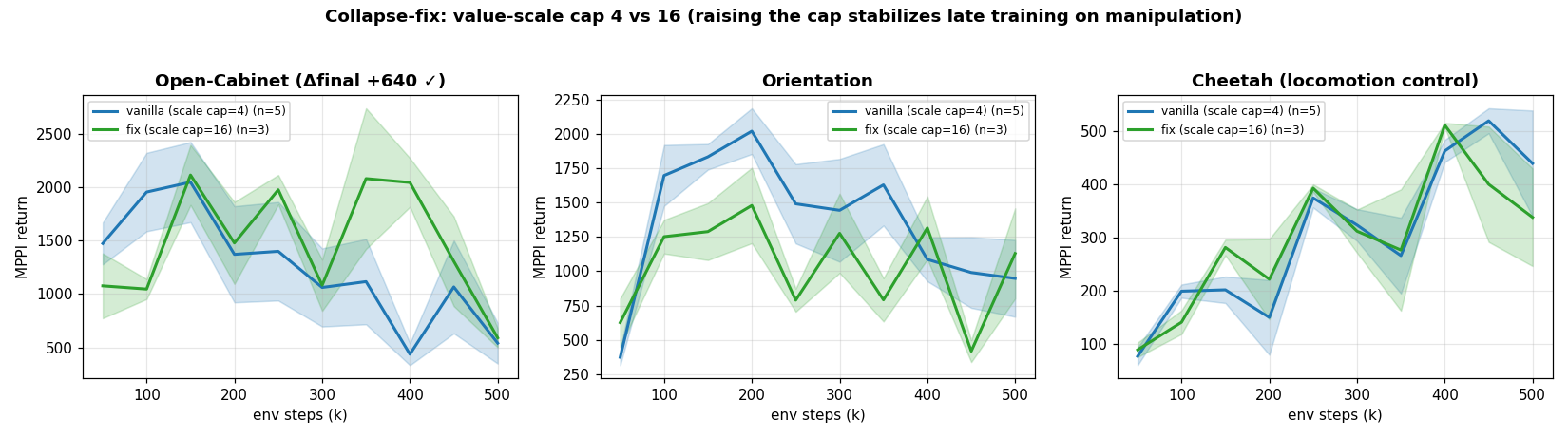
(MPPI-eval is high-variance, so the curves are jagged; the signal is in the late-training endpoint — Open-Cabinet’s fixed curve ends higher, the +640 final win.)
The fix provably stabilizes (peak-final gap shrinks on both manipulation tasks) and gives a CI-separated win on Cabinet (+640) with no locomotion harm — the first non-abstraction, non-prior-art positive signal toward beating TD-MPC2, on a mechanistically diagnosed bug class.
The nuance (important): there is no single fixed cap that wins both tasks — Cabinet’s value-IQR is large (needs ≥16), Orientation’s is smaller (16 over-normalizes its peak; ~8 is better). The optimum is task-dependent because the value-IQR is task-dependent. So the principled fix is not a bigger constant but to remove the cap entirely and let the RunningScale self-normalize to each task’s true IQR. That uncapped/adaptive variant is running now; if it wins Cabinet without costing Orientation’s peak, it’s a clean, universal, one-line improvement to TD-MPC2.
5. Methodology contributions (defensible regardless of the headline)
- Mechanism-check before fan-out: every bet gets a cheap offline gate first; this killed multiple ideas (phase-switching, kNN-SE, phase-replay) before any GPU training.
- Peak and final, paired-bootstrap CIs, pre-registered gates, single-variable, read-from-JSON — the fair protocol that repeatedly caught inflated “wins.”
- Reproducibility infra: a public benchmark/task-queue repo
(
wm-bench), a multi-GPU fleet harness, and checkpoint streaming to HuggingFace so no result is ever lost.
6. Status & decisions
- In flight:
SCALE_MAXcap sweep (find the stabilization sweet-spot that keeps Cabinet’s win without Orientation’s peak loss) → if it threads the needle, a clean universal stabilization that beats TD-MPC2. - Paper A (the redundancy criterion + null campaign) is self-contained and shippable now.
- Open question for discussion: is the right paper-B story (a) the value-scale fix (a concrete TD-MPC2 improvement), (b) a task-adaptive planner (macro-plan on contact, vanilla on locomotion → beat fixed TD-MPC2 on a mixed suite), or (c) consolidate everything into one “why world models are hard to beat, and the one place they’re not” paper.
7. Related work — what’s already done (so we don’t rebuild the wheel)
A deliberate literature pass, because several of our threads turn out to be known. We must position against these, not reinvent them.
- The collapse-fix is largely pre-empted. TD-M(PC)² diagnoses exactly our late-training failure — value overestimation from policy mismatch (the MPC planner’s buffered data doesn’t match the value/policy prior) — and fixes it with a policy constraint. Our value-scale-cap angle is a weaker, noisier variant of an already-solved problem. Do not pitch it as novel.
- Adaptive temporal resolution is a crowded space. Adaptive Temporal Abstractions from Discrete Latent Dynamics (ICLR 2024) is very close to our adaptive-jumpy idea (adaptive timescales on a discrete latent — like SimNorm). Older: Adaptive Skip Intervals (2018) already does adaptive skip-length for dynamics models. Long-Horizon Planning with Predictable Skills (RLC 2025) selects skills by predictability.
- “When does temporal abstraction help?” is partly answered. Exploring the Limits of Hierarchical World Models in RL (2024) studies exactly when hierarchy helps; and it is established that longer horizons hurt unstable/locomotion control via compounding error (TD-MPC deliberately uses a short horizon). So our “helps manipulation / hurts Hopper” regime is a reproduction of known behavior, not a discovery.
- The closest jumpy work is Farebrother et al. 2026, Compositional Planning with Jumpy World Models: jumpy models of pre-trained-policy occupancies + a multi-timescale consistency objective + planning over sequences of policies (off-policy, zero-shot), +200% on long-horizon manipulation/navigation (AntMaze-style). Different setting from ours (no policy library, online, primitive actions), but it owns the “jumpy + long-horizon planning” headline.
- Lineage (for completeness): TD-VAE and Buesing et al. (jumpy skip-step SSMs), Clockwork VAE (slow latents), Dreamer/RSSM + latent overshooting, Director / THICK (hierarchical, adaptive timescales).
8. Supervisor meeting → the honest next plan
The “trivial” critique is correct. TD-MPC2 + a k-step jumpy model are both existing, and the regime map reproduces known behavior. So the bar is: find what is not in §7.
How “adaptive” would actually work (and a key technical fact):
- k is a training parameter — the jumpy head’s input is
k·action_dim, so changing k means a different network → must retrain. n_macro is a planning parameter — used only at MPPI time → changing it is free at deployment, no retrain. So “adaptive = fine-tune k” is both expensive and trivial. - Non-trivial design: a horizon-conditioned jumpy model trained once to support multiple k (e.g., a k-conditioned macro head, or a small set k∈{1,2,4,8}), so the agent can select k and n_macro at deploy with no retraining, driven by a cheap per-task/per-state controller. To be publishable it must (i) be free-at-deploy, (ii) beat the ICLR-2024 / Adaptive-Skip methods, and (iii) ideally be grounded in the redundancy criterion (use abstraction only where the value-sufficient latent stops sufficing).
The three task diagnoses (from our data):
- Open-Cabinet: both vanilla and jumpy learn to ~1800–2800 then decline late (not “fail from the start”), and jumpy’s peak is no better (Δpeak≈0). Cabinet is multi-stage (reach→grasp→pull) → a genuine candidate for skill/temporal abstraction, if anywhere.
- HopperHop: jumpy is the wrong tool (unstable, reactive) — the most it can do is not harm (via adaptivity). Beating vanilla here needs a different lever (stability/exploration), not temporal abstraction.
- Sparse: the cartpole-sparse edge was borderline (n=5 null). We are now testing whether the sparse-benefit generalizes (AcrobotSwingupSparse, CartpoleBalanceSparse) — running. The hypothesis: longer horizon helps credit assignment to sparse rewards.
Farebrother as a baseline + AntMaze — honest scope: it’s a different setting (compose pre-trained policies, off-policy, zero-shot) with no public code, and AntMaze is not in our env backend (mujoco_playground has DMC + Panda + locomotion, no maze). A faithful head-to-head is weeks and partly apples-to-oranges. Recommended: a rigorous conceptual comparison now, expand to the longest-horizon tasks we do have, and attempt full Farebrother+AntMaze only if we commit to the skill-abstraction direction.
Is abstraction usable anywhere? — the surviving thesis (“horizon-dependent redundancy”): representation abstraction is redundant on short-horizon tasks (our criterion); but on long-horizon / compositional / sparse tasks where credit assignment, not representation, is the bottleneck (Cabinet, AntMaze, multi-stage), temporal/skill abstraction can genuinely help — which is exactly where Farebrother gets +200%. The novel, non-trivial angle is therefore: map the transition from “abstraction redundant” (short) to “abstraction necessary” (long), and build a free-at-deploy adaptive planner that switches on the criterion — positioned explicitly against TD-M(PC)² (stability axis) and the ICLR-2024/Adaptive-Skip line (adaptivity axis).
Update (post-run): the value-sufficiency sieve I ran (linear decode of the noisy MC return-to-go) turned out confounded by return variance (locomotion → low R² regardless of latent quality), so it neither supports nor refutes the criterion and is dropped; an earlier ‘sufficiency collapses with instability’ read is retracted as an artifact. The original criterion evidence stands (value is near-linear in the latent, R²≈0.999 on V(z); + 16 real nulls). Net of this session: the collapse-fix is null (n=4 clean eval), sparse does not generalize, so no method-novelty win survived — the honest deliverable is the redundancy criterion + the comprehensive null campaign.
9. Deep-research synthesis + the locked plan
An external deep-research pass (Gemini) corroborated the landscape and sharpened three corrections:
- Farebrother = Geometric Horizon Models on Temporal-Difference Flows, policy+horizon-conditioned, on OGBench (not plain AntMaze) — even more distinct from our primitive-action k-step macro.
- The RunningScale-saturation observation is unpublished — TD-M(PC)² owns the policy-mismatch account of the late collapse but does not document the numerical scale-saturation (cap=4 ≪ IQR≈16). So the late collapse is a dual failure (control mismatch + scale saturation), and the scaling half is uncharted.
- The planning-vs-representation disentanglement (macro-model uniformly accurate ⇒ locomotion failure is planning-centric) is significant and only implicitly supported elsewhere (SPlaTES, HWM).
Honest status of the three candidate prongs (Gemini’s ranking + our latest data):
- Value-Sufficiency Sieve (redundancy criterion) — the LEAD. No one has an operational, predictive “R²≥0.99 ⇒ auxiliary representation losses are null” criterion validated by a negative campaign. We are now instrumenting its core evidence: the linear value-decode R² over training and across tasks (currently a single 0.9994 number) — running.
- Decision-time adaptive horizon — deferred. Crowded (THICK/ASI/HWM/SPlaTES); only worth it if the free-at-deploy, single-model, planning-time switch clearly beats them. A build, not a quick run.
- Scale-aware fix — NULL on clean evaluation. With low-variance eval (EVAL_NEPS=10), raising/removing the RunningScale cap does not beat vanilla on Cabinet (vanilla final 1625 > cap16 1160 > uncap 1103). The earlier “+640 win” was n=3 MPPI-eval noise. So the saturation observation may be novel, but the fix does not improve performance — we will report it as a negative/clarification, not a contribution.
The paper, then, is the “critical deconstruction” (Gemini’s verdict): prove the redundancy criterion via
the value-sufficiency sieve; disentangle the locomotion-vs-manipulation regime as a planning (not
representation) failure; and report the late-collapse dual-failure honestly (policy mismatch known; scale
saturation observed; neither cap-fix nor — in our hands — a clean universal win). Honest, grounded, and not
a rebuild of TD-MPC2 + jumpy. Saved: docs/research/deep_research_gemini_2026-06-17.md.