Two years ago OpenAI’s hide-and-seek agents made a great story: pour agents into a physics sandbox, let them compete, and watch distinct strategies emerge in sharp phase transitions — box-blocking, ramp use, box-surfing. I wanted to know what the same recipe looks like on Boom, a Clash-Royale-like lane battler I run as a generational self-play league. This is an honest account of what I found. It is less cinematic than hide-and-seek, and the reasons why are the interesting part.
The setup#
Boom is a deterministic JAX game: two players, elixir economy, cards, towers,
three-minute matches. The league is simple generational self-play with gates.
Every ~21 GPU-minutes a candidate trains against a pool of past selves,
then it must beat the reigning champion over seat-swapped paired matches
with the lower bound of a 95% confidence interval above 50% to be
promoted. No CI-clearance, no crown. Every generation is also measured against
two fixed yardsticks — a random bot and a scripted rule_v0 bot — so there
is always a stationary reference.
The twist, which turned out to define everything: the game kept changing under the league. Over the campaign the engine advanced from v8 to v15 as I chased Clash-Royale mechanics parity — spell flight, charge, building knockback immunity, a tangential-slide pathing fix, the walk-retarget kiting rule, king-tower activation, pull spells. The league was never reset. It resumed and adapted across every one of those changes.
The progression curve is honest, and noisy#
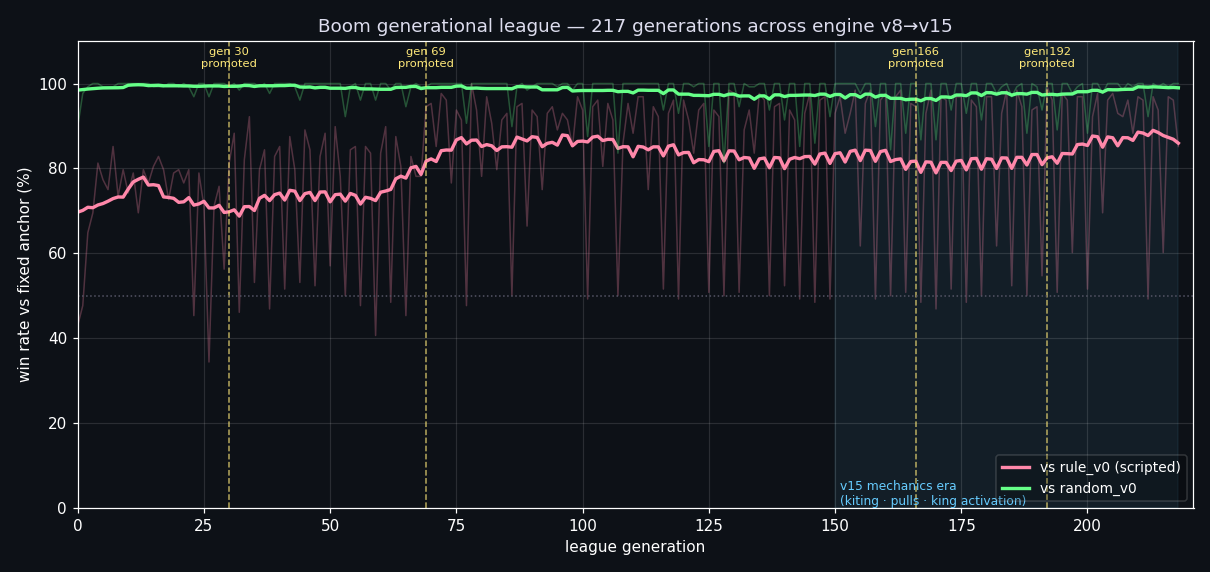
Here is win rate against the two fixed anchors across all 217 generations.
Two things jump out. First, random (green) saturates near 100% almost
immediately — it is too weak to be a useful yardstick past gen 5. Second,
rule_v0 (pink) climbs from ~70% to a plateau around 85%, with a visible step
up around gen 69 — but it is noisy and non-monotonic, dipping to 50% at
points and never becoming a clean upward sweep.
That noise is not a plotting artifact. It is the honest fingerprint of a moving target: each engine change shifted what “good play” means, and the scripted bot’s relative strength moved with it. Explorer generations, which deliberately play off-policy to find new strategies, add the sharp downward spikes. If you came expecting the tidy sigmoid of a stationary benchmark, this is the correction — real training against a changing game and a changing opponent pool looks like this.
The clean signal is transitivity#
Anchor curves are muddy. The sharper question is: is a later champion actually better than an earlier one? I played the current champion (generation 192) against four of its ancestors, 64 seat-swapped matches each.
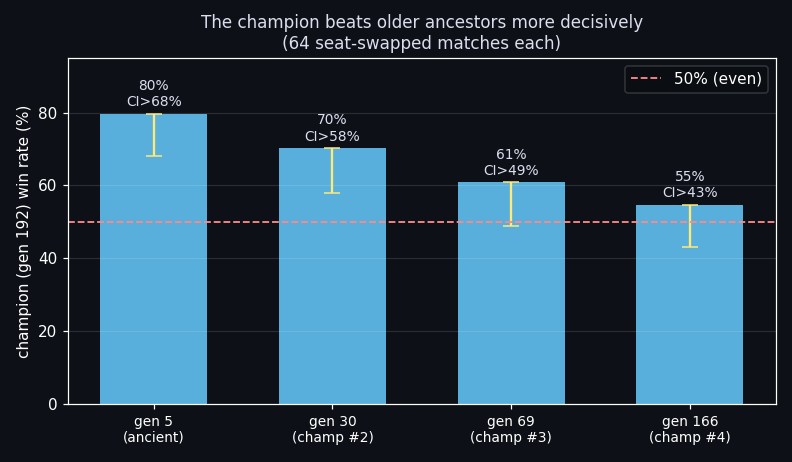
This is the result I am most confident in. The champion beats the ancient generation-5 policy 80% of the time, generation 30 70%, generation 69 61%, and the champion it directly dethroned, generation 166, 55% — a clean monotonic gradient. Newer beats older, and it beats older older more decisively. That is exactly the shape genuine, incremental progress should have. It also tells you the gains are marginal per step: promotion gates cleared at roughly 57%, and 55% over the immediately-prior champion is real but small. There is no capability explosion here — there is a ladder, climbed one careful rung at a time.
The mistake I almost published: “seat asymmetry”#
My first read of the head-to-head data was that the champion had a huge player-2 advantage — it won 94–100% of games as player 2 but only 28–59% as player 1 against the same ancestors. I wrote that down as a finding: Boom must have a big second-player edge. It was the wrong diagnosis, and catching it is the most useful thing in this post.
The two seats train with different decks. Player 0 gets a 2.6-elixir cycle deck (fast, cheap, Hog-Rider-style); player 1 gets a 3.6-elixir beatdown deck (a Giant, a Wizard, heavier units). A full elixir point apart. So the “seat” I was measuring was really a deck.
The clean way to separate the two is to play the champion against itself — identical policy, so any win-rate skew is 100% attributable to the decks:
| deck setup | player 0 wins | player 1 wins |
|---|---|---|
| cycle (P0) vs beatdown (P1) | 19% | 72% |
| mirror — both cycle | 38% | 41% |
| mirror — both beatdown | 44% | 47% |
There it is. The beatdown deck beats the cycle deck 72 to 19 in this engine; mirror matches are ~50/50 (the residual 3–5 point P0-under-P1 gap is the real, small first-player effect). There is no meaningful seat advantage. There is a lopsided card matchup, and every “seat asymmetry” number I had was just measuring which deck each seat happened to hold.
Here is that imbalance in motion — the champion playing itself, cycle deck (blue) versus beatdown deck (red). Same brain on both sides; the red deck simply wins:
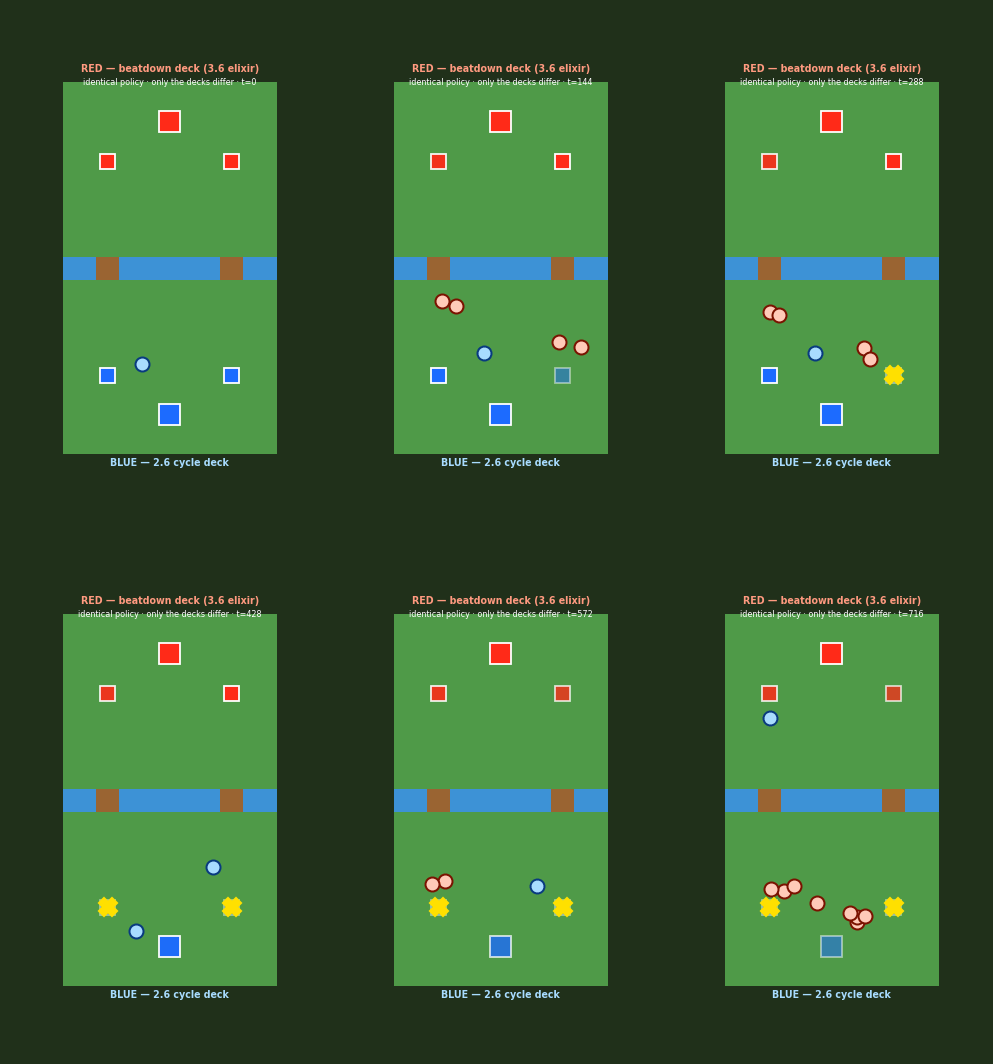
The lesson is a boring, load-bearing one: if your two seats aren’t symmetric, you are benchmarking the asymmetry, not the agent. The fix is to train and evaluate on mirror decks (both sides identical), which is the next change to the league. It is also a small balance verdict on the game itself — the default beatdown deck is over-tuned against the default cycle deck, and that wants fixing before either deck anchors a ladder.
One finding that survived#
Non-transitivity is mostly absent — but not entirely. In individual matches the champion occasionally loses to gen 5 (I caught one on the first seed I tried). Over 64 matches that washes out to a clean 80%, but the existence of rock-paper-scissors pockets is real, and it is a known reason self-play ladders can stall.
Why this is less dramatic than hide-and-seek — honestly#
Hide-and-seek had two things Boom does not. Its environment was open-ended (a physics sandbox where a genuinely new tool — a ramp, a box — unlocks a new regime), and it was stationary (the rules never moved, so a phase transition is unmistakable against a fixed backdrop). Boom is a tightly constrained card game with a fixed action space, and I deliberately kept changing its rules to chase parity. Under those conditions you should expect gradual refinement and constant re-adaptation, not sharp emergent phase transitions — and that is what I measured. I cannot honestly claim “the league discovered kiting at gen 166 because I added kiting at v15.” What I can claim is narrower and true: the last two champions were the first trained in the v15-mechanics era, the ladder kept climbing across five engine changes without a reset, and each rung is a CI-verified improvement over the last.
Takeaways#
- Self-play across a moving game works. The league adapted through v8→v15 with no resets and kept producing verified champions (30 → 69 → 166 → 192).
- Trust transitivity over anchor curves when the game is non-stationary; the anchors move, head-to-head does not.
- Check your seats are symmetric before you trust any number. I nearly published a “second-player advantage” that was really a deck matchup; champion-vs-self with mirror decks is what exposed it. Benchmark the agent, not the asymmetry.
- Emergence needs an open-ended, stationary world. A constrained, deliberately-shifting one gives you honest, incremental, hard-won gains instead — which is still exactly what you want from a competition ladder.
Every number here is from the live league’s standings file and 64-match seat-swapped evaluations run on CPU; the figures and the match GIF are generated from real trajectories, computed without disturbing the GPU training in progress.